2026: The Year AI Actually Starts Taking Jobs. Here's Who's Safe (And Who Isn't).

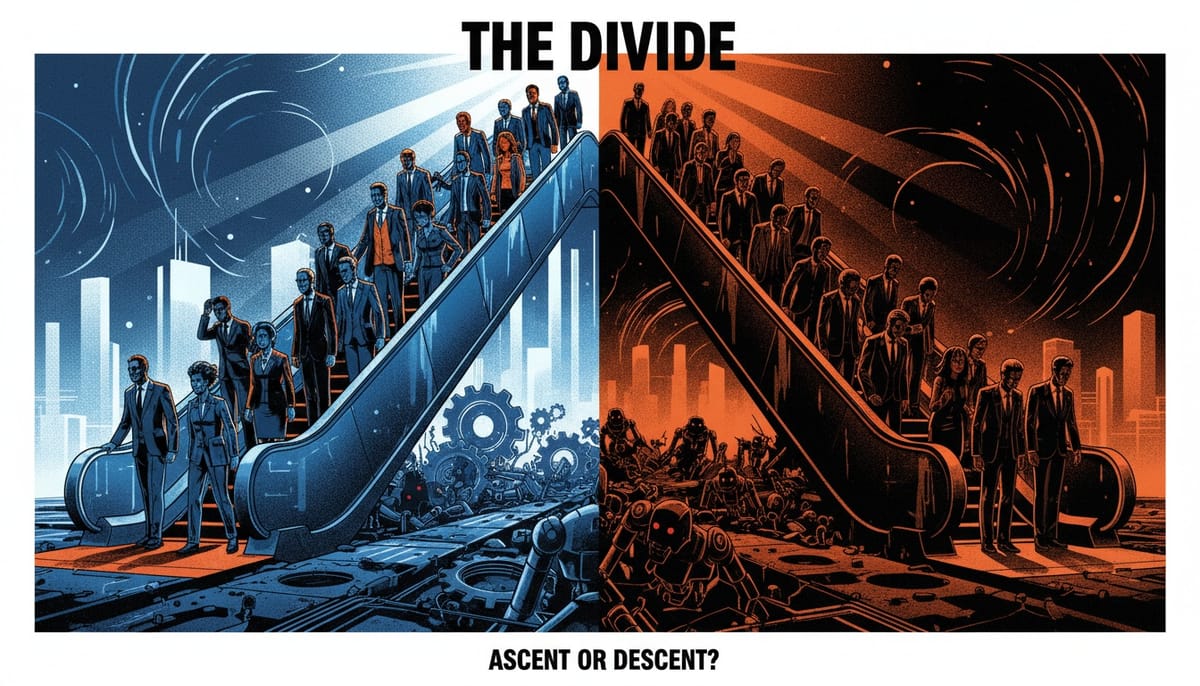
The predictions are in: 2026 is when AI stops augmenting jobs and starts eliminating them.
This isn't doomer speculation. Venture capitalists are telling portfolio companies to shift budgets from labor to AI. Enterprise software companies are building "AI employees" instead of productivity tools. And the first wave of layoffs explicitly attributed to AI capabilities—not just "restructuring"—have already started.
But here's what the headlines miss: AI isn't coming for all jobs equally. It's coming for specific types of work. Understanding the difference between "enhanced" and "eliminated" might be the most important career skill of 2026.
The Augmentation vs. Displacement Framework
Not all automation is created equal. There's a fundamental difference between:
Augmentation: AI makes you faster at your job. You're still doing the work, just with better tools. Think: a writer using AI to research faster, or a developer using Copilot to write boilerplate.
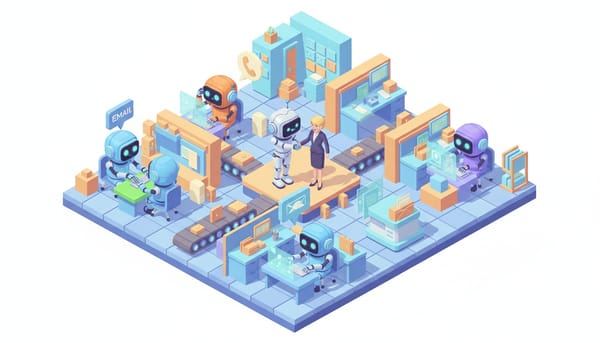
Displacement: AI does the job. You're not needed for that task anymore. Think: a chatbot handling tier-1 support tickets that previously required a human.
The distinction matters because augmentation creates more value for existing workers, while displacement creates value instead of workers.
Who's Getting Enhanced
Let's start with the good news. These roles are getting more valuable, not less:
Strategic roles. AI can't set direction. It can execute brilliantly on clear objectives, but someone has to define what "success" means. Executives, product managers, and strategists who can translate business goals into AI-executable tasks are in higher demand than ever.
Complex problem solvers. Anything requiring novel combinations of information, edge case handling, or "this situation is different" judgment calls. AI is terrible at knowing when the rules don't apply. Consultants, senior engineers, and anyone whose value is "figuring out the hard stuff" is safe.
Relationship builders. Sales that depend on trust, client management that requires empathy, partnerships that need human rapport. AI can qualify leads and draft emails, but closing a six-figure deal still requires a human across the table.
Creative directors. Not the people who make things—the people who decide what should be made and whether it's good. AI can generate 100 logo options in seconds; someone still needs to know which one is right for the brand.
AI wranglers. The people who make AI work. Prompt engineers, AI ops specialists, people who can bridge the gap between "what the AI can do" and "what the business needs done." This is the new IT department.
Who's Getting Displaced
Now the harder conversation. These roles are being eliminated, not enhanced:
First-response anything. Tier-1 support, initial customer inquiries, basic troubleshooting. If the job is "follow a script and escalate exceptions," AI does it better, faster, and 24/7. Companies are already running 80%+ of customer interactions through AI with equal or better satisfaction scores.
Routine data processing. Data entry, basic analysis, report generation, spreadsheet manipulation. If the job can be described as "take data from here, transform it, put it there"—it's already automated or will be within months.
Scheduling and coordination. Meeting scheduling, travel booking, appointment management. Executive assistants whose primary value was calendar management are being replaced by AI assistants that integrate with everyone's calendar automatically.
Content at scale. Not quality content—but volume content. Product descriptions, basic blog posts for SEO, social media filler, email variations. If the goal is "produce 1000 pieces of adequate content," AI wins.
Junior research. The "go find me information about X" tasks that used to train junior analysts. AI can synthesize information from hundreds of sources faster than a human can read ten. Entry-level research positions are disappearing.
The Uncomfortable Middle
Here's where it gets complicated. Some roles are in a gray zone where the outcome depends entirely on how companies choose to use AI:
Software development. Junior devs doing routine coding are at risk. Senior devs who can architect systems and review AI-generated code are enhanced. The question is whether companies will hire fewer juniors or hire the same number and get more output.
Marketing. Campaign execution is getting automated. Strategy is getting enhanced. But there's a middle layer—the people who translate strategy into execution—where AI is creating uncertainty.
Legal. Document review is automated. Complex litigation is enhanced. But associate-level work that's "smarter than a template but not yet partnership material" is being squeezed from both sides.
Healthcare. Diagnosis assistance is augmentation. Administrative tasks are displacement. But the line between "doctor with AI tools" and "AI with doctor oversight" is blurring.
The Real Pattern
If you look across all these categories, a pattern emerges:
Displaced: Tasks that are rule-based, high-volume, and quality-tolerant (meaning "good enough" is acceptable).
Enhanced: Work that is judgment-heavy, novel, and quality-sensitive (meaning "good enough" isn't acceptable).
The displacement happens when AI reaches "good enough" threshold. The enhancement happens when AI can't reach it alone but can help humans reach it faster.
What This Means for You
Three practical takeaways:
1. Move up the judgment stack. If your job is executing well-defined tasks, start developing the skills to define those tasks. The people who decide what to do are safer than the people who do it.
2. Become AI-fluent. Not necessarily technical—but operationally fluent. Know what AI can and can't do. Know how to work with it effectively. The people who can leverage AI will outperform those who compete with it.
3. Double down on human edges. Relationship building, creative judgment, ethical reasoning, handling ambiguity. These are the things AI is worst at and humans are best at. Make them your specialty.
The Honest Take
Here's what I believe: 2026 will be disruptive, but not catastrophic. AI will eliminate some jobs entirely. It will transform more. And it will create new ones we haven't imagined yet.
The winners won't be people who ignore AI or people who panic about AI. They'll be people who understand exactly where AI excels and where it falls short—and position themselves accordingly.
The robots aren't coming for everyone. But they are coming for specific types of work. The question is whether you're doing that work or not.
At Geta.Team, we build AI employees that handle the "displaced" work—so your human team can focus on the "enhanced" work. Try it here: https://Geta.Team