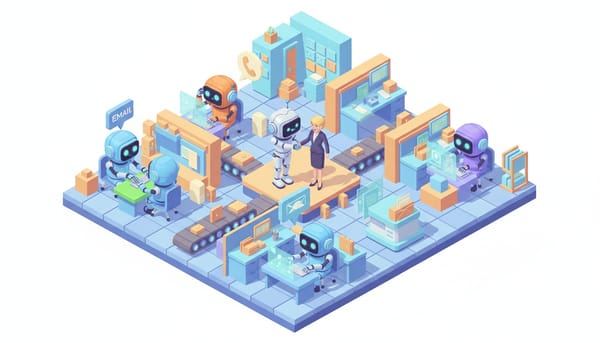
2026: The Year Companies Stop Backfilling Jobs


Nobody's getting laid off. That's what makes 2026 different.
Silicon Valley VCs are sounding alarms about AI displacing workers, but they're not predicting mass layoffs. They're predicting something quieter: companies simply won't replace people who leave.
A TechCrunch survey of enterprise VCs revealed a consistent theme—2026 is the year AI stops being a productivity tool and starts absorbing headcount. Not through dramatic announcements, but through thousands of small decisions not to backfill roles.
The Math Behind the Quiet Disappearance
The numbers are stark. An MIT study found that 11.7% of jobs could already be automated using current AI technology. Half of employers surveyed plan to reduce their workforce where AI can automate tasks. Projections suggest unemployment could climb to 6% this year—not from layoffs, but from attrition that never gets replaced.
Here's how it works: Your marketing coordinator leaves for another opportunity. In the past, you'd post the job listing within a week. Now? Someone suggests trying an AI tool for those social media posts and email campaigns. "Just for a month or two, while we figure out hiring." That month becomes permanent.
Your customer service rep retires. Instead of hiring a replacement, you route tickets through an AI system. It handles 70% of inquiries without human intervention. The remaining 30% gets distributed among existing staff.
Death by a thousand small decisions.
Why This Hits Entry-Level Workers Hardest
The cruelest part of this shift is where it lands. Entry-level roles—the positions that traditionally served as on-ramps into careers—are vanishing fastest.
Many of the jobs that once served as entry points for young workers are being reshaped or hollowed out by automation. Junior copywriters, research assistants, basic data entry, first-tier support—these are exactly the tasks AI handles well.
The jobs that remain increasingly demand experience, digital fluency, or specialized skills from the outset. Young workers are expected to arrive "AI-ready," yet they're offered fewer opportunities to learn on the job.
It's a brutal catch-22: you need experience to get hired, but the jobs that used to provide that experience no longer exist.
The Companies Already Making This Shift
This isn't theoretical. Telus has more than 57,000 team members regularly using AI, saving 40 minutes per AI interaction. Suzano developed an AI agent that cut query time by 95% across 50,000 employees.
These companies aren't firing people. They're simply operating with fewer new hires than they would have needed five years ago.
Gartner predicts that 40% of enterprise applications will embed AI agents by the end of 2026, up from less than 5% in 2025. That's not gradual adoption—that's a transformation happening in real-time.
The New Reality: Roles, Not Jobs
Futurists predict 2026 will see wholesale job redesign. Instead of hiring humans to fill complete roles, companies decompose jobs into tasks—then distribute those tasks between humans and AI systems.
Your next "hire" might be three-quarters AI employee, one-quarter human oversight. The human doesn't do the work; they direct, supervise, and refine the work the AI produces.
New roles are emerging: AI workflow designers, automation auditors, prompt strategists. These professionals guide and optimize AI systems. But these positions require skills most workers don't yet have—and the training infrastructure barely exists.
What This Means for Business Owners
If you're running a company, you're facing a choice. You can wait for each departure to become a crisis, scrambling to figure out AI solutions under pressure. Or you can proactively build your AI workforce now.
The businesses thriving in 2026 aren't the ones who eliminated jobs. They're the ones who strategically deployed AI employees alongside humans—handling the routine work that used to consume entry-level staff, freeing experienced workers to focus on judgment, relationships, and strategy.
An AI employee doesn't call in sick. It doesn't need onboarding. It doesn't leave for a competitor after you've spent six months training it. And it costs a fraction of a human hire.
The math is uncomfortable, but it's also clear.
The Path Forward
This shift isn't inherently good or bad—it's structural. The question isn't whether AI will absorb roles that used to require humans. It already is.
The question is whether you're prepared. Whether your team has the AI fluency to direct these systems. Whether your business has the infrastructure to integrate AI employees effectively.
The companies that figure this out first will operate leaner, move faster, and scale without the constraints that come with traditional hiring. The ones that don't will watch competitors pull ahead while they're still posting job listings that take three months to fill.
2026 isn't the year of mass layoffs. It's the year of quiet replacement. The desks are emptying—not with drama, but with silence.
The only question is whether your business is ready to fill them differently.
Want to see how AI employees actually work? Geta.Team deploys AI virtual employees that handle real tasks—email, research, customer support, content creation—with persistent memory and the ability to learn your business. Try it here: https://Geta.Team