
32% of Companies Plan to Cut Jobs Because of AI. The Data Says They're Wrong.

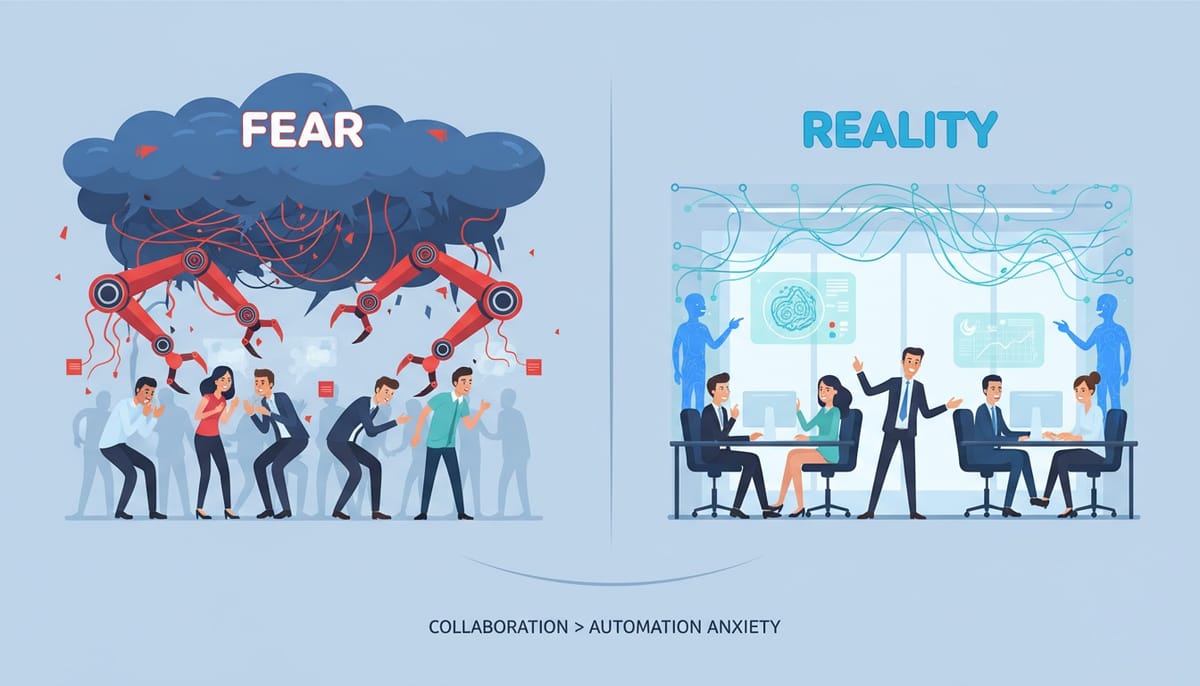
A third of companies are planning workforce cuts because of AI. According to McKinsey's latest survey, 32% of organizations expect to reduce headcount as artificial intelligence takes over tasks previously done by humans.
There's just one problem: the data says they're wrong.
Thirty-three months after ChatGPT's release—the moment everyone assumed would trigger mass unemployment—the labor market tells a completely different story. No apocalypse. No wave of layoffs. Just... stability.
The Fear vs. The Facts
The Yale Budget Lab released a comprehensive analysis this month examining whether AI has actually disrupted employment since November 2022. Their conclusion? "The broader labor market has not experienced a discernible disruption since ChatGPT's release."
That's not what anyone expected. When ChatGPT hit 100 million users faster than any technology in history, the prediction machine went into overdrive. Goldman Sachs warned that 300 million jobs could be affected. The World Economic Forum estimated 85 million jobs displaced by 2025. Headlines screamed about the end of white-collar work.
Yet here we are, nearly three years later, and the unemployment rate looks... normal.
What's Actually Happening
Before you conclude that AI is overhyped, let's look at where the impact actually exists.
The St. Louis Fed found that computer and mathematical occupations—the jobs most exposed to AI—did see higher unemployment increases than less-exposed roles. Tech specifically has felt the pinch: 77,999 tech job losses were directly attributed to AI in the first half of 2025 alone.
But here's the nuance everyone misses: AI isn't replacing workers across the board. It's reshaping specific functions within specific industries. Cloud computing, web search, and computer systems design stopped growing at the end of 2022. These were the canaries in the coal mine—and they stayed canaries. The broader economy didn't follow.
Why? Because less than 10% of firms are actually using AI regularly. Even in professional and technical industries—where you'd expect maximum adoption—only 20% report consistent AI use.
The apocalypse is on backorder because most companies haven't figured out how to deploy AI yet.
Why Companies Get This Wrong
So why do 32% of executives plan to cut jobs for a technology their companies barely use?
Three reasons:
They're confusing capability with deployment. Yes, AI can theoretically do many knowledge work tasks. But "can" and "will" are separated by implementation complexity, integration costs, change management, and a hundred other organizational realities. Executives see demos and extrapolate to mass unemployment. The workers actually using these tools see the gap between demos and daily reality.
They're anchoring on fear, not evidence. The narrative that AI eliminates jobs is pervasive and compelling. It's also, so far, empirically wrong. But fear is a powerful motivator—especially when it lets executives justify workforce cuts they wanted to make anyway.
They're ignoring historical patterns. Computers didn't become commonplace in offices until nearly a decade after they were available to the public. It took even longer for them to actually transform workflows. AI will likely follow a similar trajectory: slow adoption, gradual integration, eventual transformation—not overnight revolution.
The Real Story No One Wants to Hear
Here's what the data actually supports: AI is creating a job market shift, not a job market collapse.
The World Economic Forum's own research—the same organization warning about 85 million displaced jobs—also projects 97 million new roles emerging. That's a net positive of 12 million positions globally.
This pattern is consistent with every major technological shift in history. ATMs didn't eliminate bank tellers—bank branch expansion actually increased teller employment for decades. Excel didn't eliminate accountants—it made them more productive and expanded the scope of financial analysis work.
The jobs AI eliminates won't disappear into a void. They'll transform into different jobs, often at the same companies, often requiring many of the same people.
What Smart Companies Are Actually Doing
The companies that understand this aren't cutting workers. They're redeploying them.
When AI handles routine data analysis, the analyst doesn't get fired—they spend more time on interpretation and strategy. When AI drafts initial customer responses, the support rep doesn't disappear—they handle complex escalations that require human judgment.
This is exactly what we're seeing at organizations that have deployed AI thoughtfully. The FDA, as we wrote about recently, gave every employee access to AI agents. They didn't cut their workforce—they accelerated their review processes while keeping the same number of reviewers.
The 32% of companies planning job cuts are solving for the wrong problem. They're treating AI as a cost reduction tool when the real opportunity is capability expansion.
The Question You Should Actually Be Asking
If your company is planning workforce reductions because of AI, ask this: what evidence supports that decision?
Not what AI could theoretically do. Not what vendors promise in demos. Not what analysts predict might happen someday.
What is AI actually doing in your organization right now that justifies eliminating human positions?
If you can't answer that question with specifics—actual workflows automated, actual productivity gains measured, actual roles made redundant by deployed systems—you're making a fear-based decision, not an evidence-based one.
The labor market data is clear: 33 months of ChatGPT, and no apocalypse. Maybe the 32% planning cuts should look at the same data before making decisions that will be difficult to reverse when they realize they were wrong.
Want to test the most advanced AI employees?
Try it here: https://Geta.Team