66% of Leaders Won't Hire Without AI Skills. Here's What That Actually Means for Your Career.

A new survey just landed with a number that should wake up anyone currently job hunting: 66% of business leaders say they won't hire candidates who lack AI skills.
Not "prefer candidates with AI skills." Won't hire without them.
This isn't a future prediction. It's happening now. And if you're still treating AI literacy as optional, you're about to find out how fast "optional" becomes "mandatory."
The Bifurcation Is Real
Here's what the data actually shows:
According to IDC, up to 40% of all Global 2000 job roles will involve working with AI agents by the end of 2026. Not using AI occasionally—working with AI agents as part of the core job function.
Meanwhile, a separate study found that companies are already eliminating entry-level positions because AI handles the work those roles used to do. The traditional "start at the bottom, learn on the job" path is compressing. Fast.
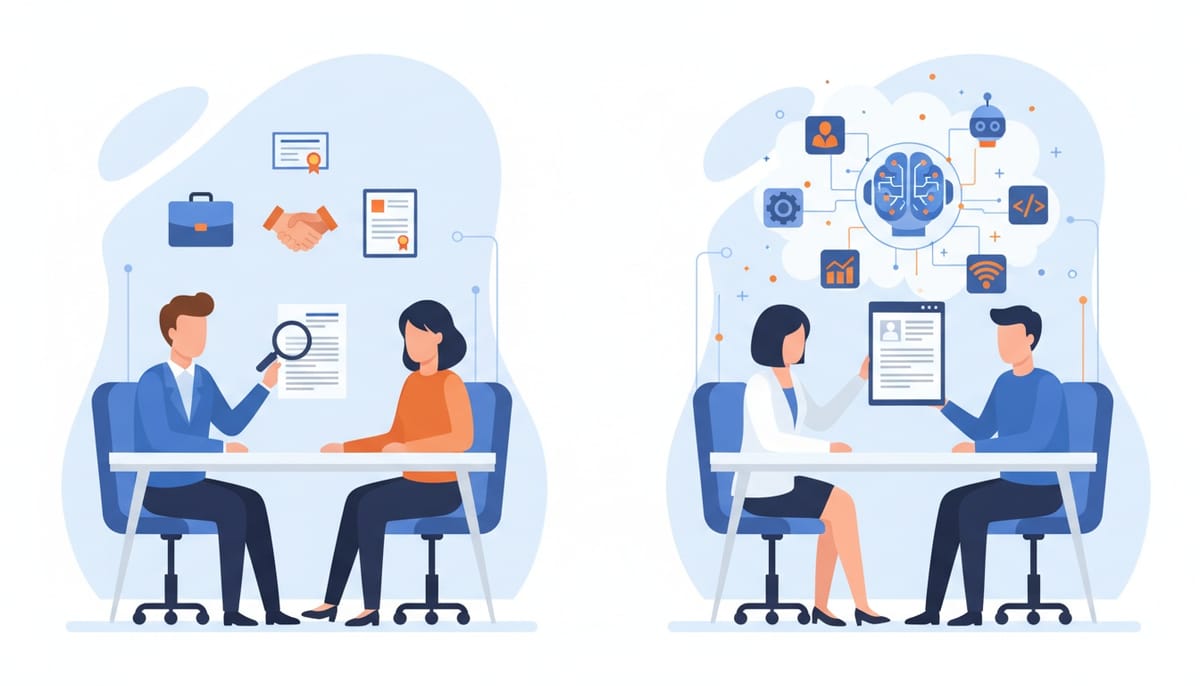
The workforce is splitting into two tracks:
Track 1: AI-Enabled. You know how to work alongside AI agents. You can direct them, evaluate their outputs, and integrate them into your workflows. You're more productive, handle more complexity, and—critically—you're hireable.
Track 2: AI-Absent. You either don't know how to use AI effectively, or you're actively avoiding it. You're competing for a shrinking pool of roles that don't require AI competency. And that pool gets smaller every quarter.
The brutal part? Companies aren't waiting for you to catch up. They're hiring from Track 1 and letting Track 2 figure it out on their own.
What "AI Skills" Actually Means
Here's where most people get confused. They hear "AI skills" and think:
- "I need to learn to code machine learning models"
- "I need a data science degree"
- "I need to understand transformer architectures"
No. That's not what employers mean when they say AI skills.
What they actually mean is:
1. You can work with AI tools effectively. You know how to prompt an AI assistant to get useful outputs. You understand when AI is helpful and when it's going to waste your time. You can evaluate whether an AI-generated output is good or garbage.
2. You can integrate AI into workflows. You don't just use ChatGPT for one-off questions. You understand how AI fits into a process—how to automate the repetitive parts, when to insert human judgment, and how to create reliable systems that include AI components.
3. You can supervise AI agents. This is the emerging skill. AI agents don't just answer questions—they execute tasks autonomously. Someone needs to define what they should do, monitor their work, and course-correct when they drift. That's a human job. But it requires understanding how agents work.
4. You can evaluate AI outputs critically. AI hallucinates. It makes confident mistakes. It generates plausible-sounding nonsense. The skill isn't trusting AI blindly—it's knowing when to trust it and when to verify.
None of this requires a PhD. It requires practice and intentionality.
The Entry-Level Squeeze
The hardest-hit group? Entry-level candidates.
Traditionally, entry-level roles existed because companies needed humans to do work that was too simple to justify senior salaries. Data entry. Basic research. First-pass document review. Scheduling. Routine customer inquiries.
AI handles most of that now.
So companies face a choice: hire an entry-level person who needs training, supervision, and time to become productive—or deploy an AI agent that works 24/7, doesn't need benefits, and improves automatically.
The math isn't close.
This doesn't mean entry-level jobs disappear entirely. It means the bar rises. Entry-level now means: you can do what AI can do, plus you bring uniquely human capabilities—judgment, creativity, relationship-building, complex problem-solving. And you can work with AI to amplify those capabilities.
If you're just entering the workforce without AI fluency, you're already behind.
What To Do About It
If the 66% stat made you uncomfortable, good. Here's how to get on Track 1:
Start using AI daily. Not occasionally. Daily. Use it for writing drafts, summarizing documents, brainstorming ideas, debugging problems. Build the muscle memory.
Learn to evaluate outputs. The skill isn't prompting—it's judgment. When AI gives you an answer, check it. Develop an intuition for when outputs feel wrong. Get good at verification.
Understand AI agents, not just assistants. Chatbots answer questions. Agents execute tasks. Learn how agents work—how they plan, use tools, and maintain context. This is where the job market is heading.
Document your AI workflows. When you accomplish something using AI, write down how you did it. What prompts worked. What tools you combined. This becomes your portfolio—proof that you're AI-enabled.
Stay current. AI capabilities change quarterly. What was impossible six months ago might be standard now. Follow the developments. Experiment with new tools. Treat AI literacy as a continuous practice, not a one-time learning event.
The Timeline Is Now
The 66% stat isn't a warning about 2030. It's describing hiring decisions happening today.
If you're currently employed, you have a window to develop these skills while you still have a job. Use it.
If you're job hunting, every application you submit is competing against candidates who are AI-enabled. Either you're one of them, or you're not.
The bifurcation is real. The question is which track you're on.
Building AI fluency for your team? Geta.Team deploys AI employees that work alongside humans—showing your team how human-AI collaboration actually works in practice.