A Google Engineer Just Admitted Claude Code Did a Year's Work in One Hour. Here's What That Means for Your Team.

A Google Engineer Just Admitted Claude Code Did a Year's Work in One Hour. Here's What That Means for Your Team.
On January 3rd, 2026, Jaana Dogan—a principal engineer on Google's Gemini API team—posted something on X that made 5.4 million people stop scrolling.
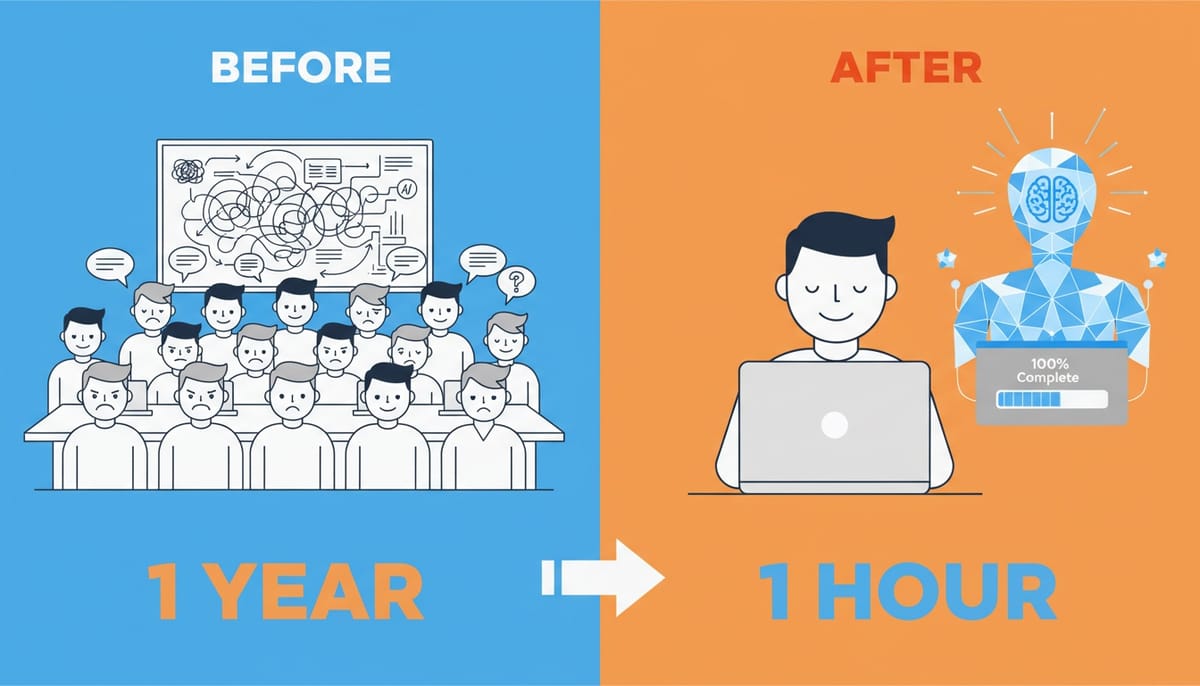
"I'm not joking and this isn't funny," she wrote. "We have been trying to build distributed agent orchestrators at Google since last year. There are various options, not everyone is aligned... I gave Claude Code a description of the problem, it generated what we built last year in an hour."
Read that again. A year of work at one of the world's most advanced engineering organizations, reproduced in sixty minutes.
The Real Story Isn't About Speed
Before you dismiss this as hype, consider what Dogan actually revealed. She wasn't comparing a polished production system to a quick prototype. She was exposing something far more uncomfortable: the brutal inefficiency of how large organizations build software.
Her team spent 2024-2025 creating multiple versions of the same system. Not because the problem was impossibly hard, but because "not everyone is aligned." Different factions. Different approaches. Organizational friction.
Claude Code didn't have that problem. It just built the thing.
Paul Graham caught this immediately: "It illustrates an aspect of AI that I hadn't thought about till now: it cuts through bureaucracy."
The Expertise Paradox
Here's what most coverage missed. Dogan herself said it clearly: "It takes years to learn and ground ideas in products...once you have that insight, building isn't that hard anymore."
She fed Claude Code a three-paragraph description. No proprietary details. Just a clear articulation of the problem from someone who deeply understood it.
This is the paradox: AI coding tools don't replace experienced engineers. They amplify them. Dogan's decade of distributed systems expertise became the input. Claude Code became the output mechanism.
An intern with the same tool wouldn't have produced the same result. They wouldn't know what to ask for.
What This Actually Means for Engineering Teams
The bottleneck has shifted. It's no longer "can we build this?" It's "do we know what to build, and can we articulate it clearly?"
Organizations that still measure engineering productivity in lines of code or story points are measuring the wrong thing. The scarce resource isn't implementation anymore. It's clarity of thought.
Companies clinging to traditional engineering headcount ratios are going to look very strange in twelve months. If one senior engineer with AI tools can match the output of a team, why does that team still exist?
Some are already asking this question. Others are pretending it's not happening.
The Uncomfortable Truth About Alignment
Dogan's confession reveals a second, quieter crisis. Google—with its legendary engineering culture—spent a year with teams that couldn't agree on a direction.
This isn't unique to Google. Every large organization has teams duplicating work, building competing versions, waiting for approvals that never come. The AI didn't just write code faster. It bypassed an entire layer of organizational dysfunction.
That's not something you can fix with a better project management tool.
Where This Leaves Us
Dogan ended her thread graciously: "Claude Code is impressive work, I'm excited and more motivated to push us all forward."
But the implications are unavoidable. If an AI tool can collapse a year of organizational effort into an hour, we're not looking at a productivity improvement. We're looking at a fundamental restructuring of how software gets built.
The engineers who thrive in this environment won't be the ones who code fastest. They'll be the ones who think clearest, articulate problems best, and waste the least time on organizational friction.
That's the real lesson from Dogan's confession. The AI didn't just write code. It exposed everything that was slowing the humans down.
At Geta.Team, we build AI employees that work alongside your team—not as replacements, but as amplifiers of your existing expertise. See how our AI employees integrate with your workflow →