
AI Agent Digest: Week 13, 2026 — Claude Goes Desktop, Visa Pays by Agent, Mastercard Hires a Virtual CFO

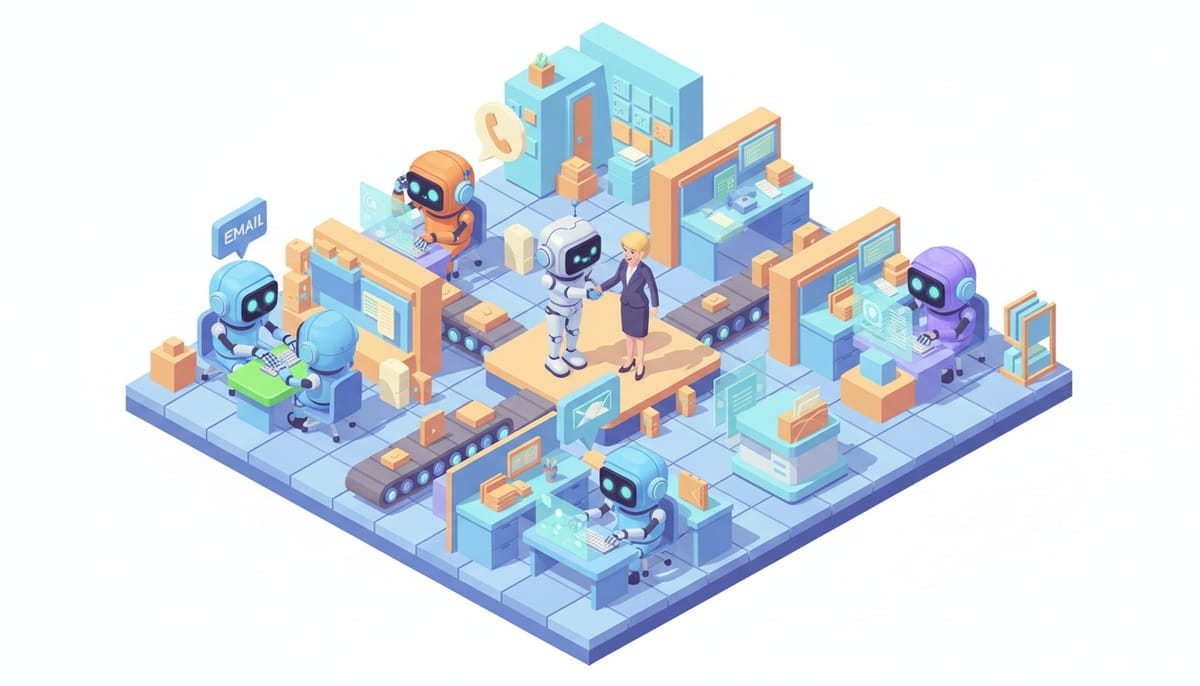
This was the week AI agents stopped being a category and started becoming infrastructure. Visa built payment rails for them. Mastercard hired one as a CFO. Anthropic put one on your desktop. Here are the ten stories that mattered.
1. Anthropic Launches Claude Dispatch — Your Desktop Is Now an Employee's Workspace
Anthropic released Claude Dispatch as a research preview, first rolling out to Max plan subscribers. The setup is deceptively simple: scan a QR code with your phone, and Claude gets persistent access to your Mac. Open apps, navigate browsers, fill spreadsheets — all while you're away. One developer reported roughly 50% task success rate.
Hot take: Fifty percent is not great. But Anthropic is not selling reliability here — they're selling a paradigm. The moment "assign a task from your phone and walk away" becomes normal, every AI company is competing on that UX, not on benchmark scores. This is Anthropic declaring that the chatbox era is over.
2. GPT-5.4 Ships with Native Computer Use and 1M Context Window
OpenAI released GPT-5.4 in three variants — standard, Thinking (reasoning), and Pro (max performance). It's their first model with native computer-use capabilities, packs a 1 million token context window, and includes a "tool search" feature that lets agents dynamically discover the right tool for the job. 33% fewer factual errors than GPT-5.2.
Hot take: The 1M context window is the real story, not computer use. Computer use is a feature. A million-token context window is an architectural shift — it means agents can ingest entire codebases, full financial quarters, or years of email history in a single pass. That changes what "autonomous" actually means.
3. NVIDIA GTC: Chips Built for Agents, Not Just Models
Jensen Huang's GTC 2026 keynote introduced the Vera Rubin platform (seven chips as one system), a new Language Processing Unit built from Groq's acquired technology, and OpenShell — a sandboxed runtime for enterprise agents. The NemoClaw stack now includes an AI-Q Blueprint for agentic search that tops accuracy leaderboards.
Hot take: NVIDIA is no longer a chip company. They're building the entire agent stack from silicon to sandbox. OpenShell is the quiet bombshell — enterprise security teams have been blocking agent deployments for months because "we can't control what it does." NVIDIA just handed them a policy engine.
4. Mastercard Launches a Virtual CFO for Small Businesses
Mastercard introduced Virtual C-Suite, starting with a Virtual CFO that gives SMBs automated financial analysis, risk insights, forecasting, and scenario simulation — powered by data from 175 billion annual transactions. More virtual executive roles (security, marketing, operations) are planned.
Hot take: When Mastercard — not a startup, not a VC-backed experiment — sells "virtual executives" to small businesses, the market is validated. Full stop. Every company in the AI employee space just got its biggest proof point handed to it by a Fortune 500 incumbent.
5. Visa Says AI Agents Can Now Make Payments
Visa launched Visa Agentic Ready, onboarding 21 European banks (Barclays, HSBC, Revolut, Commerzbank) to test agent-initiated payments. Santander completed Latin America's first end-to-end agent-powered purchases across five countries. Visa also shipped a CLI tool for agents to make crypto payments and announced support for Stripe's Machine Payments Protocol.
Hot take: Visa and Mastercard both moved on agent commerce in the same month. That is not a coincidence — it's coordination with inevitability. When the financial plumbing is rebuilt for AI agents as first-class economic actors, the question flips from "will agents transact?" to "how fast will humans be removed from the payment loop?"
6. White House Drops First Federal AI Framework — Light Touch, Heavy Implications
The Trump Administration released a seven-pillar National Policy Framework for AI, urging Congress toward sector-specific regulation with federal preemption of state laws. No new federal AI agency. Regulatory sandboxes for development. And the spiciest line: "training of AI models on copyrighted material does not violate copyright laws."
Hot take: The copyright stance is a gift to every AI company and a gut punch to every creator. But the federal preemption clause is what matters for businesses — if it passes, you stop worrying about 50 different state AI laws and start building. Whether you agree with the politics, the regulatory clarity is real.
7. 45,000 Tech Layoffs in March — 9,200 Explicitly Because of AI
Global tech layoffs hit 45,000 in early 2026, with over 9,200 directly attributed to AI and automation. Block (Square/Cash App) cut from 10,000 to under 6,000 employees — the largest single workforce reduction explicitly linked to AI capability. CEO Jack Dorsey: "This is not driven by financial difficulty, but by the growing capability of AI tools."
Hot take: Jack Dorsey said the quiet part out loud. These aren't recession layoffs. These aren't "restructuring." A CEO publicly stated that AI can do work that 4,000 humans were doing, and acted on it. The debate about whether AI replaces jobs is officially over. The debate now is how fast.
8. MCP Crosses 97 Million Monthly Installs
Anthropic's Model Context Protocol — now donated to the Linux Foundation's Agentic AI Foundation — hit 97 million monthly SDK downloads. Every major provider (Anthropic, OpenAI, Google, Microsoft, Amazon) ships MCP-compatible tooling. The emerging consensus stack: MCP for tool access, A2A for agent-to-agent communication, WebMCP for web access.
Hot take: MCP won. The standards war is over before most people realised there was one. Three protocols (MCP/A2A/WebMCP) are becoming the TCP/IP of agentic AI. If your agent platform isn't MCP-compatible, you're building on a dead end.
9. Gumloop Raises $50M from Benchmark for No-Code Agent Building
Gumloop raised a $50M Series B led by Benchmark, with Shopify Ventures, Y Combinator, and First Round Capital participating. The platform lets employees build autonomous AI agents without coding — onboarding, invoice reconciliation, support triage, CRM updates. Customers include Shopify, Ramp, Gusto, and Instacart.
Hot take: Benchmark doesn't lead $50M rounds on vibes. They're betting that the next wave of enterprise software isn't "buy an agent" but "every employee builds their own." That's a fundamentally different market than what most AI agent companies are building for — and it might be the right one.
10. Apple Preparing Siri Agent Overhaul — Powered by Gemini
Apple is readying a full Siri AI agent overhaul for iOS 26.4/26.5, powered by Google Gemini under a deal reportedly worth $1 billion per year. The new Siri will understand cross-app context (pulling flight info from Mail, reservations from Messages) and act as a true agent. Bloomberg reports iOS 27 will open Siri to third-party AI assistants beyond ChatGPT.
Hot take: Apple is the last company to do anything, which means when they do it, the market shift is irreversible. Agent-based interfaces are no longer an enterprise experiment — they're about to be the default interaction model for two billion iPhone users. The iOS 27 open ecosystem is the real prize: it could become the distribution channel every AI assistant startup has been dreaming about.
What We're Watching Next Week
- Claude Dispatch adoption data — will the 50% success rate improve as users learn the paradigm?
- Congressional response to the White House AI framework — will federal preemption gain traction?
- More agent commerce pilots — which banks go live first with Visa Agentic Ready?
- Apple WWDC countdown — any early iOS 26.4 agent features in developer betas?
Bottom Line
This week drew a clear line. On one side: companies still debating whether AI agents are ready. On the other: Visa rebuilding payment rails, Mastercard selling virtual executives, and the U.S. government deploying agentic operating systems across 150 medical centres. The infrastructure layer is being poured. The question is no longer "if" — it's whether you're building on it or watching it set.
At Geta.Team, we've been building AI employees that actually execute work — with persistent memory, native integrations, and real communication channels — since before "agentic" became a buzzword. If this week proved anything, it's that the market is finally catching up to the vision.