AI Just Split the Job Market Into Two Tracks. Here Is Which One You Want to Be On.

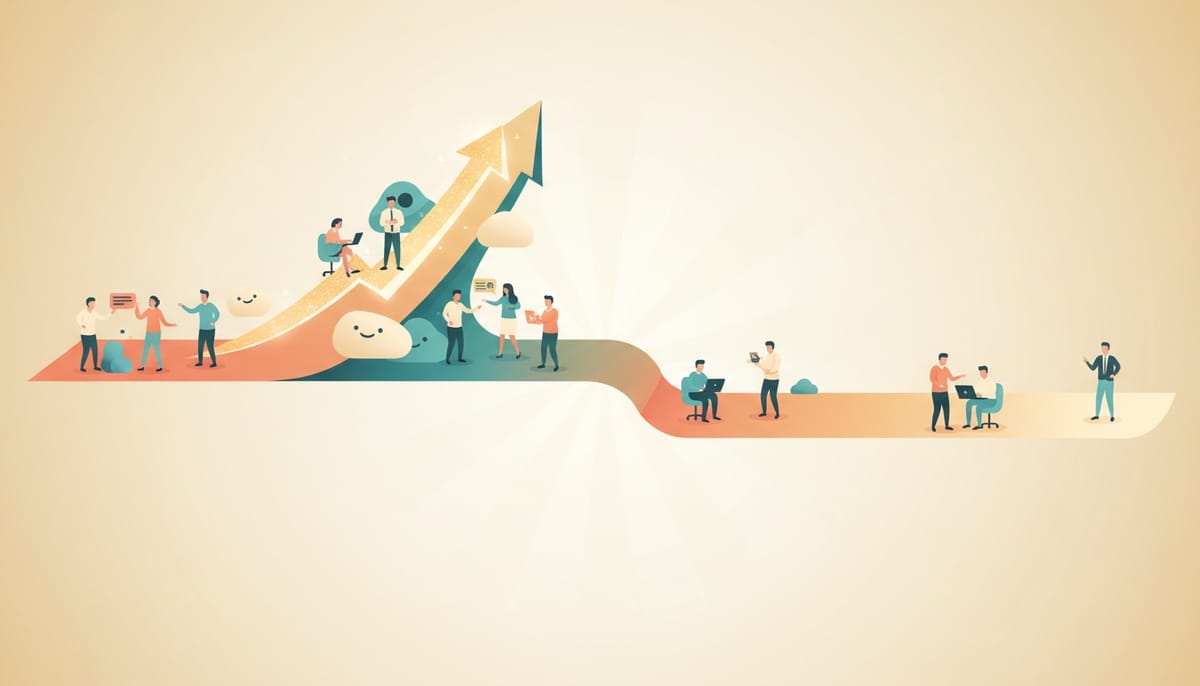
The headline everyone fears about AI and jobs is "how many will it destroy." PwC just analyzed more than a billion job ads across 27 countries and found a more interesting answer: AI is not deleting the job market, it is splitting it in two. And the two halves are pulling apart fast.
PwC's 2026 Global AI Jobs Barometer calls the split professionalised versus democratised. The names are a little academic, so here is the plain version, because which side of this line your role lands on is about to matter a great deal.
The two tracks
A job gets professionalised when AI takes over the routine parts and, in doing so, raises the bar on the human parts. The work that is left is the harder, more expert, more judgment-heavy work, so the role demands more of you, not less. PwC's examples are radiologists and recruiters: AI handles the volume, and the human is freed up to do the difficult, high-stakes thinking that was always the actual point of the job.
A job gets democratised when AI makes it easier for non-experts to do. The tooling smooths the path so much that you no longer need deep expertise to perform the role at all. PwC points to IT service managers and medical secretaries. This sounds like the good outcome, the accessible one, and in a fairness sense it is. But watch what it does to the economics.
Here is the finding that should reorganize how you think about your own career: professionalised jobs are growing twice as fast as democratised ones, with 42% faster wage growth since 2021.
Read that again. The track where AI makes you more of an expert is the one expanding and paying more. The track where AI makes your job easier for anyone to do is growing slower and paying less. Easier is not winning. Deeper is.
Why "easier" loses
It is counterintuitive until you think like a market. When AI democratises a role, it enlarges the pool of people who can do it. More supply, same or softer demand, and wages drift down while growth flattens. The tool that made your job accessible to everyone also made you more replaceable by everyone.
When AI professionalises a role, the opposite happens. The routine work that used to fill your day gets absorbed by the machine, and what remains is the scarce stuff: judgment, synthesis, the call that does not have a clean answer. That scarcity is exactly what a market pays a premium for. You did not get automated away. You got concentrated into the part of the work that was always the most valuable.
The rest of the Barometer backs this up from every angle. Firms with the highest AI exposure grew headcount 52% since 2018, versus 36% for the least exposed, and grew wages 24% versus 17%. The companies leaning hardest into AI are hiring more people and paying them more, not fewer and less. And the wage premium for workers with AI skills hit 62% this year, up from 57%, reaching as high as 118% in some sectors. AI is not draining the labor market. It is concentrating its rewards on the people who move up the expertise track and bring AI with them.
Which track you actually want, and how to get on it
The instinct, when a tool makes your job easier, is relief. Take it. But the Barometer is quietly warning that relief is the wrong target. If the AI you adopt only makes your existing work easier, you are riding the democratised track, the slower-growing, lower-paying one. The move is to use AI to climb, not to coast: let it take the routine off your plate so you can spend your hours on the judgment-heavy work that markets are bidding up.
That is a choice about how you deploy the tools, not just which tools you buy. An AI that drafts your emails so you can send more emails has democratised you. An AI that handles the inbox, the scheduling, the first-pass research, and the repetitive follow-ups so you can spend your day on the decisions only you can make has professionalised you. Same technology. Opposite tracks.
This is the whole idea behind how we think about AI employees at Geta.Team. The point was never to replace the human or to make the human's job merely easier. It is to pull the routine, repeatable, time-eating work off a person's plate, an AI coworker triaging the inbox, managing the calendar, chasing the follow-ups, holding the context, so the human is freed to do the expert, creative, relationship, and judgment work that does not automate and that the market increasingly pays a premium for. That is what climbing the professionalised track looks like in practice: not a person doing less, but a person doing more of what only a person can do.
The fear that AI will hollow out the workforce makes a better headline than the truth. The truth, in PwC's billion data points, is that AI is forking the workforce, and one fork is rising. The 92 million roles some forecasts expect to disappear by 2030 are real, but so are the 170 million expected to be created, for a net gain. The question was never whether there will be work. It is which track your work sits on, and whether you are using AI to climb it or to stand still.
Pick the track where the machine handles the routine and you handle the call. That is the one that is growing, and that is the one that pays.
Want to test the most advanced AI employees? Try it here: https://Geta.Team