AI Models Are Becoming Commodities. The Value Just Shifted to Implementation.


Last week, Jensen Huang watched an Austrian developer's open-source AI agent platform go viral and called it "definitely the next ChatGPT." Wall Street panicked. Not because OpenClaw was bad — but because it proved something investors had been dreading: AI models are becoming interchangeable.
The stock market reaction was predictable. If anyone can swap GPT-5 for Claude for DeepSeek for an open-source alternative and get roughly the same results, where exactly is the moat? Where does the $1 trillion in AI company valuations actually live?
Here's the thing. That panic is completely justified — but only if you're an AI model company. If you're a business using AI, this is the best news you've gotten all year.
The Price Collapse Nobody Expected
The numbers are almost absurd. ChatGPT API pricing dropped from $0.03 per 1,000 tokens in 2024 to $0.002 in early 2026. That's a 93% reduction in two years. DeepSeek V4 came in at 95% cheaper than GPT-4 — and performance benchmarks barely flinched. Open-source models that would have been state-of-the-art eighteen months ago now run on a single GPU.
NVIDIA flooded the market with H100 GPUs in late 2025. Cloud providers suddenly had three times the compute capacity versus the previous year. And Fortune 500 CFOs, who'd been writing $2-10 million annual AI checks, started asking uncomfortable questions about ROI.
The result? A pricing war that made cloud storage's race to the bottom look leisurely.
Swapping Models Is Now Routine
Here's what changed in practice: enterprises stopped betting on one model. A January 2026 industry survey found 37% of firms now run five or more models simultaneously — GPT-5.2 for complex reasoning, Claude for coding, Gemini for multimodal tasks, DeepSeek for budget workloads. LangChain became the production standard for multi-model orchestration. Data portability improved to the point where you can export memory and preferences from one model and drop them into another.
Gartner projects that by 2028, 70% of enterprises will route AI traffic through model-agnostic gateways — up from less than 5% in 2024. The model itself is becoming a utility. Like electricity. You don't care which power plant generated it. You care what you plug into the outlet.
So Where Did the Value Go?
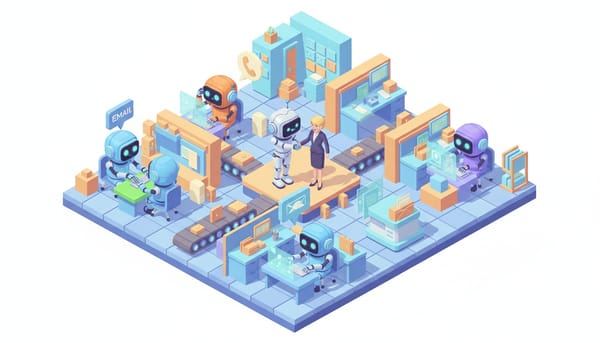
This is where it gets interesting. While model pricing cratered, the implementation layer — everything you build on top of the model — became the only defensible competitive advantage.
Think about it: 95% of generative AI pilots never reach production. Not because the models aren't good enough. The models are incredible. They fail because the architecture around them — memory, orchestration, governance, integration, skill creation — isn't there.
A technically mediocre AI system that's deeply embedded in customer workflows will outperform a technically superior system that's loosely coupled every single time. The model is the engine. But the engine was never what made a car company successful. It's the chassis, the transmission, the user experience, the dealer network, the financing.
The agentic AI market is projected to grow from $10.91 billion in 2026 to $52.62 billion by 2030. Gartner says 40% of enterprise applications will embed task-specific AI agents by end of this year — up from less than 5% in 2025. That growth isn't happening because models got better. It's happening because the implementation layer finally caught up.
What the Winners Look Like
The companies getting this right share a few patterns:
They treat model choice as a configuration setting, not an architectural decision. When your platform is model-agnostic, a 95% price drop from a competitor becomes an opportunity, not a threat. You switch. You save. You move on.
They invest in memory and context, not prompt engineering. The difference between a chatbot and a colleague is memory. A colleague remembers your preferences, your communication style, the context of last week's conversation. That memory layer — persistent, searchable, growing — is where the real value compounds over time.
They build skills, not features. Instead of hardcoding capabilities, the best implementations let users create custom skills on demand. Need your AI to manage a specific CRM workflow? Don't wait for a product update. Build the skill. Deploy it. Done.
They own their data. Enterprise open-source AI deployment jumped from 23% to 67% year-over-year — a 340% increase. The primary driver? 73% cited customization and data sovereignty. When AI models are commodities, the proprietary data you feed them becomes your moat.
Why This Is Actually Great News
Model commodification sounds scary if you're OpenAI or Anthropic. But for everyone else, it means:
Lower costs. Obviously. When models compete on price, businesses win.
No vendor lock-in. Your AI platform shouldn't hold you hostage. If Claude releases something better tomorrow, you should be able to switch by changing an API key — not rebuilding your infrastructure.
Focus on what matters. The model war is someone else's problem. Your problem — the interesting one — is figuring out how AI agents actually do useful work in your specific business. That's an implementation challenge, not a model selection challenge.
Transparent pricing. The Bring Your Own API (BYOA) model — where you connect your own API key and pay the provider directly — is gaining traction specifically because it eliminates the middleman markup. When models are commodities, paying a 3x markup for someone to wrap an API is indefensible.
The Bottom Line
The AI industry just went through its cloud storage moment. The raw compute — the model itself — is heading toward commodity pricing. The value migrated upstream to the implementation layer: agent architecture, persistent memory, skill creation, workflow orchestration, and data governance.
That's not a crisis. It's a clarification. The companies that understood this early — that built platforms on top of models rather than around them — are the ones positioned for what comes next.
The question isn't which AI model you're using anymore. It's what you've built on top of it.
Want to test the most advanced AI employees? Try it here: Geta.Team