"Hybrid Human-AI Teams" Is Becoming the 2026 Buzzword. Here's the Four-Part Test for Whether Yours Is Real.

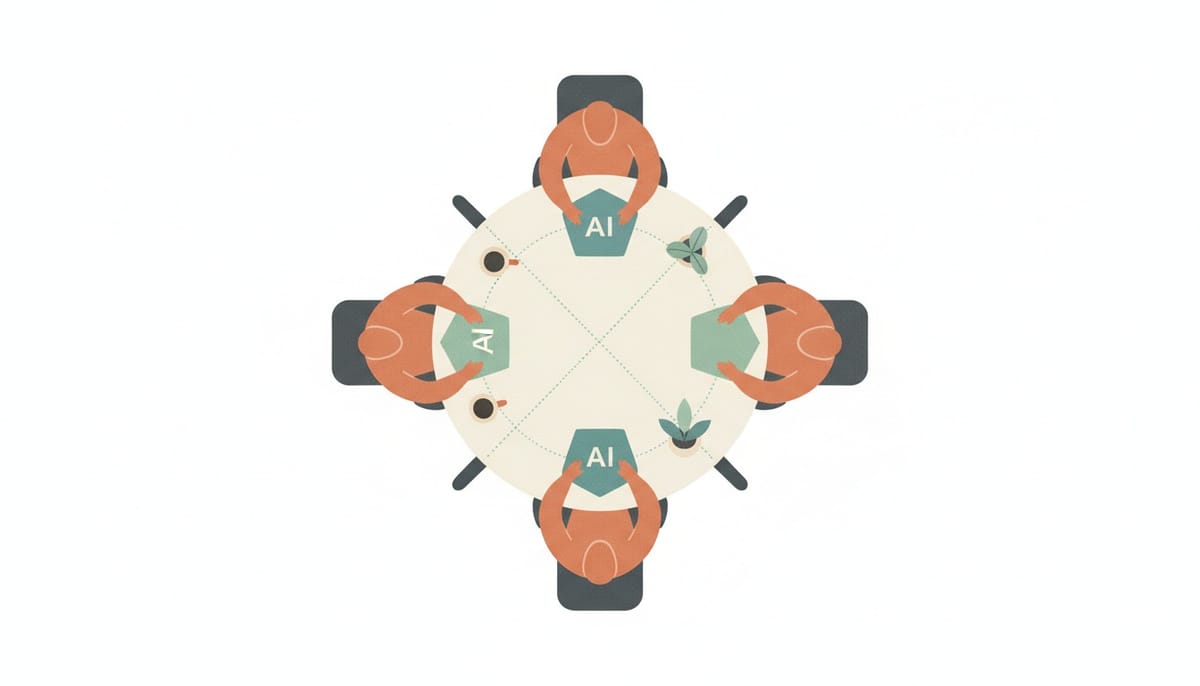
"Hybrid human-AI team" was a phrase you'd hear three times at a conference six months ago. Now it's in everyone's keynote, every consulting deck, and three of the four pitches that landed in our inbox last week. By Q3, it'll be on the side of buses.
That's not, by itself, a problem. The phrase is pointing at something real — workplaces are getting AI coworkers and figuring out how to operate around that fact. The problem is that the term has detached from the thing. Most "hybrid teams" being announced are not hybrid teams. They are humans using a Slack bot, slightly differently than they were six months ago.
Here's the test, in four parts, for whether what you have is actually hybrid or just relabeled.
1. Does the AI coworker have its own identity?
A human teammate has a name, a calendar, an email address, a Slack handle, and a place they appear in the org chart. If your "AI coworker" is a tool that lives behind a button that one human pushes, you don't have a hybrid team. You have a human with a power-up.
The line is whether vendors and clients can interact with the AI coworker directly without going through a human gatekeeper. If your sales AI doesn't have its own email address that prospects can reply to, it's not on the team — it's a feature of someone's workflow. That distinction looks pedantic until you watch what happens when the gatekeeping human goes on vacation.
This is the criterion most "hybrid teams" fail first. The test is: can your AI coworker receive a Slack DM, a calendar invite, and an email — and respond on its own — without a human in the middle? If yes, real coworker. If no, you have a tool.
2. Does it remember anything from last week?
Real teammates compound context. They remember that the Tuesday client preferred the second option. They remember that Q3 starts in May for this account. They remember the apology email from last month so they don't accidentally re-litigate it.
Most "AI coworker" implementations remember nothing. Each session starts at zero. The marketing materials say "memory" because there's a vector DB attached, but the memory is stored as embeddings of past chats — semantic search, not actual recall. The agent can find that the conversation happened; it can't operate as if the conversation happened.
The test: ask your AI coworker on Tuesday what was decided in Monday's meeting. If the answer requires you to re-paste the meeting notes, you don't have a teammate. You have a chatbot with a longer context window.
Real coworker memory is typed and queryable: facts (the client uses Q3-starts-May), decisions (we ruled out the cheaper plan in March), preferences (Joseph likes terse confirmations), current focus (the partnership review is the big thing this week). Without that structure, you have a search index, not a colleague.
3. Does it hand off cleanly?
Humans hand work to each other constantly. Sales hands a closed deal to onboarding. Onboarding hands the customer to support. Support escalates to engineering. The handoff is mostly invisible because it's been refined for centuries — there are conventions, expected artifacts, and a shared sense of what "done" means.
AI coworkers in real hybrid teams hand off the same way. The sales AI marks a deal closed and writes a structured fact to memory; the onboarding AI reads that fact and starts the welcome sequence; the support AI inherits the customer's history because it's all in one shared memory layer. No human has to sit in the middle and copy-paste.
In fake hybrid teams, every handoff requires human translation. Sales saves a Notion page; somebody copies the link into Slack; somebody else pastes the relevant fields into the onboarding tool. The "AI" is doing the work in each station, but the connective tissue between stations is still entirely human, which means the team still scales linearly with the number of humans.
The test: when work crosses a station boundary in your team, does a human do the carrying, or does it move on its own through the shared layer?
4. Is there a feedback loop you'd recognize from a real team?
Real teams give each other feedback. A senior engineer corrects a junior's code. A manager flags a missed deadline. A peer pushes back on a draft.
Most "hybrid teams" have no equivalent. The AI coworker does work; the human reviews or corrects; nothing about the AI's behavior changes the next day. There's no learning loop, no "performance review," no documented cases the AI was wrong and had to recalibrate. Every Monday is groundhog day.
A real hybrid team has explicit feedback structure. Corrections from humans become memory writes that change the AI coworker's future behavior. Patterns of human-flagged errors become updated instructions in the AI's profile. The AI gradually learns the team's specific definition of "good" — same as a junior would in the first six months.
The test: can you point to three specific behaviors your AI coworker does differently this month than last, in response to feedback? If yes, real team. If no, your "hybrid team" is humans plus a static tool that hasn't evolved since onboarding.
What's actually underneath the buzzword
Strip out the marketing and the real definition of a hybrid human-AI team is small, sharp, and pretty demanding:
A team where AI coworkers have their own identity, persistent typed memory, can hand off work directly to other AI coworkers and humans through a shared layer, and adjust their behavior based on team feedback.
That's it. That's the whole bar. Most products being sold under "hybrid team" today fail at least three of those four. They have AI doing work, and humans using the AI, but no AI coworker behavior in any meaningful sense.
The buzzword will keep growing. The reality will catch up slowly, because the four criteria above require a substrate (shared memory, identity, handoff, feedback) that almost no off-the-shelf "agent platform" has. Most are still selling smarter chatbots.
If you're shopping in this category — for your own team or for a client's — ask the four questions before you sign. The vendors who can answer all four cleanly are vanishingly rare. The ones who can't will tell you it's coming on the roadmap. It probably isn't.
Want to test the most advanced AI employees? Try it here: https://Geta.Team