Multi-Agent Systems Had a 1,445% Surge in Interest. Single Agents Are Dead.

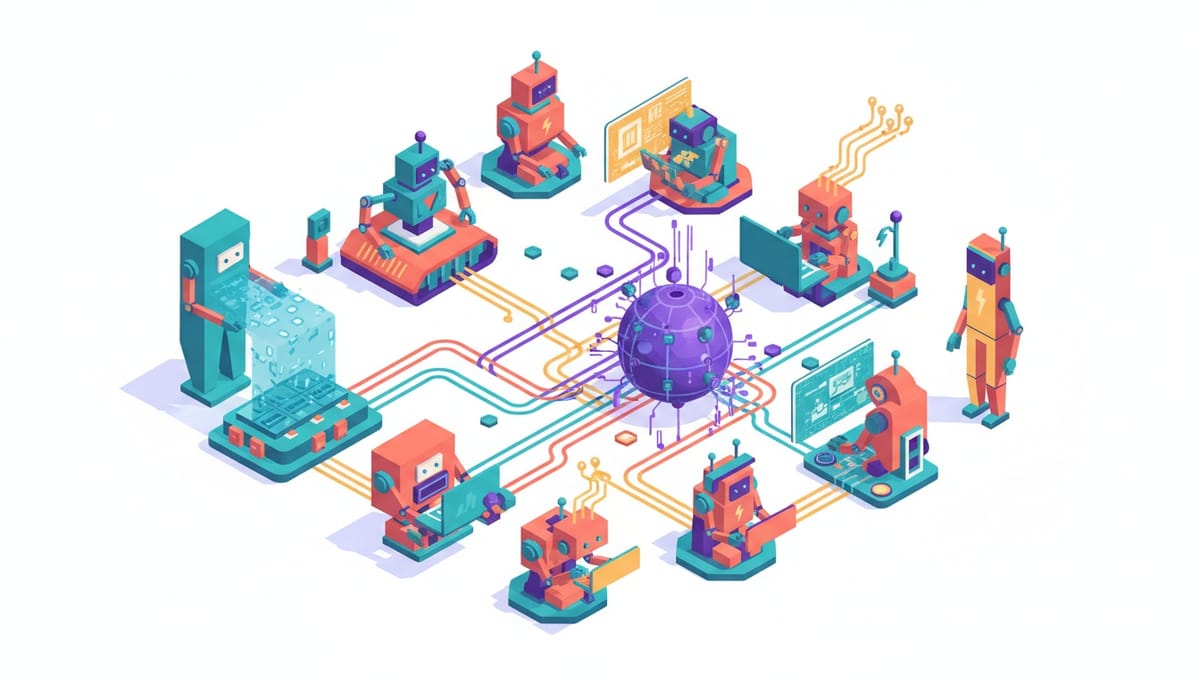
The same lesson software learned 15 years ago with microservices, AI agents are learning now: one agent can't do everything.
Gartner reported a 1,445% surge in multi-agent system enquiries between Q1 2024 and Q2 2025. That's not a typo. The interest in orchestrating multiple specialised AI agents -- rather than relying on a single all-purpose one -- has exploded in barely a year.
And it's not just curiosity. KPMG's Global Head of AI and Data Labs predicts that 2026 will be the year we see "orchestrated super-agent ecosystems, governed end-to-end by robust control systems." Salesforce reports that 80% of CEOs expect humans and AI agents to work together, with nearly three-quarters believing most employees will have an AI agent reporting to them within five years.
The monolithic agent is dying. Here's why, and what's replacing it.
The Single-Agent Ceiling
If you've tried building an AI agent that handles more than one domain, you've hit the wall. A single LLM-powered agent asked to manage emails, analyse data, write content, and handle customer queries will inevitably degrade. Context windows fill up. Tool-calling accuracy drops as you add more functions. The agent becomes a jack of all trades and a master of none.
Anthropic's internal testing revealed that loading 58 tools into a single agent's system prompt consumed roughly 55,000 tokens -- before the agent even started working. Worse, as the number of tool options increases, the model's ability to select the correct one decreases. You're paying more for worse results.
This mirrors exactly what happened in software engineering. Monolithic applications worked fine until they didn't. The moment complexity crossed a threshold, teams discovered that a single codebase trying to do everything became unmaintainable, undeployable, and unreliable.
The fix then was microservices. The fix now is multi-agent systems.
How Multi-Agent Orchestration Actually Works
Instead of one agent with 50 tools, you deploy multiple agents with 5-8 tools each. Each agent owns a specific domain -- email management, data analysis, content creation, customer support -- and an orchestration layer routes tasks to the right specialist.
This architecture delivers three immediate advantages:
Accuracy goes up. When an agent has a narrow scope and fewer tools, its selection accuracy improves dramatically. A content agent doesn't need to know how to query databases. A data analyst agent doesn't need email-sending capabilities.
Costs go down. Instead of loading every tool definition into every request (burning tokens on context the agent won't use), each specialist only loads its own toolkit. Dynamic tool discovery can reduce token usage by 85%, from roughly 77,000 to 8,700 tokens per request.
Reliability improves. When one agent fails, the system doesn't collapse. The orchestrator can retry, reroute, or escalate -- just like a well-designed microservices architecture handles partial failures gracefully.
The Orchestration Challenge
Multi-agent systems aren't free of complexity. They trade one set of problems for another.
The orchestrator itself needs to understand intent well enough to route tasks correctly. Agents need to share context without duplicating it. State management across multiple agents requires careful design. And observability becomes critical -- when something goes wrong in a chain of agent handoffs, you need tracing to find where it broke.
This is why 65% of enterprise leaders cite agentic system complexity as their top barrier, and it's been the number one concern for two consecutive quarters. Building multi-agent systems requires a new engineering discipline that sits somewhere between distributed systems design and AI prompt engineering.
But the organisations that solve this are seeing real results. The ROI metric for AI in 2026 has shifted from tokens generated to tasks completed. Multi-agent systems complete more tasks because each agent does its narrow job well, rather than one agent doing many jobs poorly.
Why This Matters for Your Business
You don't need to build multi-agent orchestration from scratch. The market is maturing rapidly, with frameworks like CrewAI and LangGraph making it more accessible, and platforms emerging that handle the orchestration layer entirely.
The question isn't whether you'll adopt multi-agent systems. It's whether you'll be early enough to gain the advantage.
Consider what a multi-agent team looks like in practice. An executive assistant agent manages your calendar and travel. A customer success agent handles onboarding and support tickets. A marketing agent creates and schedules content. A sales agent qualifies leads and manages your CRM. A data analyst agent builds dashboards and forecasts.
Each one is purpose-built. Each one has its own memory, its own tools, its own communication channels. They collaborate when needed but don't step on each other's work. This isn't a thought experiment -- it's how the most forward-thinking companies are structuring their AI workforce right now.
The 2026 Playbook
If you're still running a single chatbot or a monolithic AI assistant, here's the path forward:
Start with one specialist. Pick the highest-ROI use case in your business -- usually email management or customer support -- and deploy a dedicated agent for it. Get it working reliably before expanding.
Add agents incrementally. Each new agent should own a clearly defined domain. Resist the urge to make any single agent "smart enough" to handle adjacent tasks.
Invest in orchestration early. The coordination layer between your agents is where most of the complexity lives. Whether you build or buy, this is the infrastructure that determines whether your multi-agent system scales or collapses.
Measure tasks, not tokens. The only metric that matters is work completed. How many support tickets resolved? How many leads qualified? How many reports generated? If your AI can't point to completed work, it's expensive middleware.
The monolithic agent era lasted about two years. Multi-agent systems are where the industry is heading, and the 1,445% surge in interest suggests most enterprises already know it. The question is execution.
At Geta.Team, this is exactly how we built our platform -- six specialised AI employees, each with their own skills, memory, and communication channels, working as a coordinated team rather than a single overwhelmed chatbot. Because one agent can't do everything. But the right team of agents can.