The Chatbot Era is Dead. Microsoft Just Confirmed It.

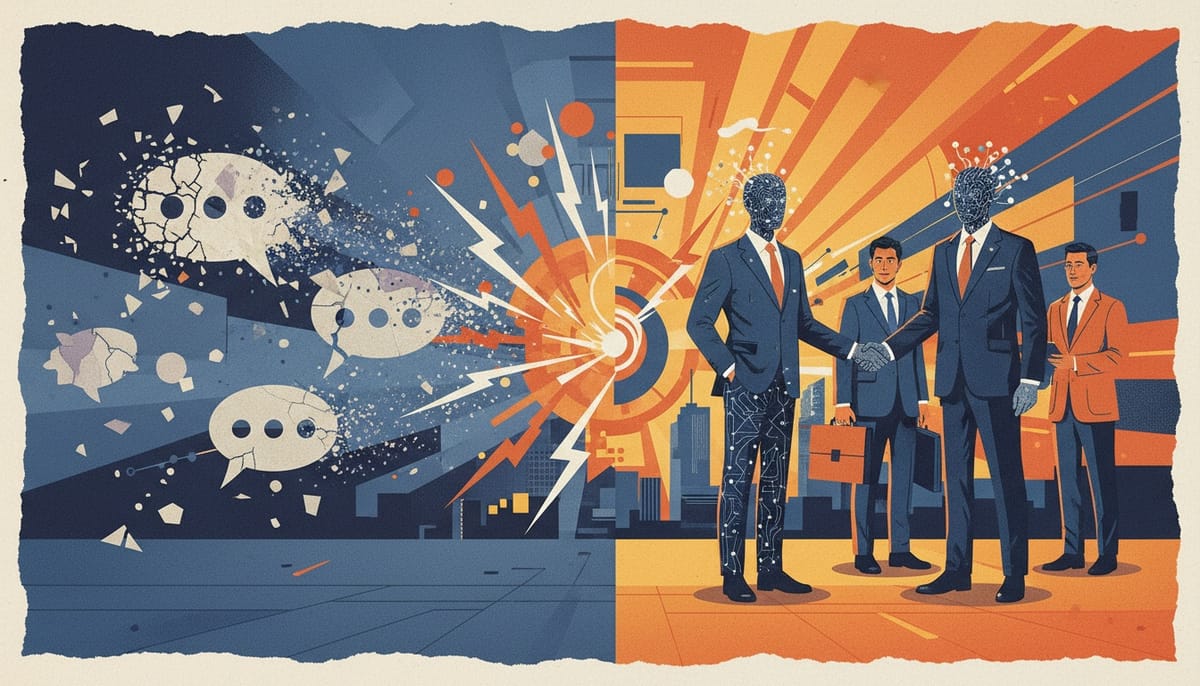
Microsoft didn't mince words. In their latest enterprise briefings, they're calling it "the end of the chatbot era." And if you've spent any time wrestling with those "How can I help you today?" pop-ups that couldn't actually help with anything, you probably felt a little vindication reading that headline.
But this isn't just Microsoft trash-talking their own earlier products. It's a signal of something much bigger happening across the entire industry.
The Numbers Tell the Story
Gartner just dropped a prediction that should make every business leader pay attention: 40% of enterprise applications will embed AI agents by the end of 2026. That's up from less than 5% in 2025. We're talking about an 800% increase in a single year.
This isn't incremental improvement. This is a category shift.
The difference between a chatbot and an AI agent isn't just semantic. Chatbots wait for you to ask questions. They respond. They're reactive by design—fancy search boxes with personality.
AI agents? They work. They take actions. They handle multi-step processes without you holding their hand through each click.
What Microsoft Actually Built
Microsoft Copilot is undergoing what they're calling "a major architectural shift." Instead of responding to individual commands, Copilot is becoming a collection of specialized autonomous agents.
Here's what that looks like in practice:
Sales Development Agent connects to your CRM (Salesforce, Dynamics 365, whatever you're running) and handles pipeline building, lead nurturing, and personalized outreach. Not suggesting what to write—actually writing it, sending it, following up.
Expense Management Agent doesn't wait for you to submit receipts. It monitors, categorizes, flags anomalies, and processes approvals autonomously.
SharePoint Administration Agent handles the soul-crushing work of permissions management, content organization, and compliance monitoring that used to eat up IT hours.
The key word in all of this: autonomously. These agents act on triggers—an incoming customer inquiry, a shift in market data, a scheduled workflow—and operate asynchronously. You don't have to initiate each action. They just run.
Why This Matters More Than You Think
The shift from "tool you use" to "coworker you work with" isn't just a marketing angle. It changes how businesses operate at a fundamental level.
Consider the math. If your sales team spends 30% of their time on outreach preparation, and an AI agent handles that work, you've just added 30% capacity to every seller without hiring anyone. That's not automation in the "set up a rule" sense. That's workforce multiplication.
But here's where it gets interesting for businesses that aren't Fortune 500 enterprises with Microsoft's ear.
The enterprise players are moving fast, but they're also dealing with what analysts are calling "Agent Sprawl"—the challenge of managing hundreds or thousands of autonomous agents running across different systems without clear governance. It's the new version of shadow IT, except now it's shadow workers.
Smaller businesses have an advantage here. You can adopt the AI coworker model without the governance overhead, because you're not managing thousands of agents. You're adding one or two to your team. Testing, learning, iterating.
The Real Question
The chatbot era dying isn't news to anyone who's actually tried to use a chatbot for something complex. What's news is that the replacement architecture is now production-ready.
The question isn't whether AI agents are coming to enterprise software. They're already here. Microsoft is deploying them. Google is bringing agents into search that handle entire transactions. Salesforce built them into their platform. The infrastructure exists.
The question is whether you adopt this model now—while you can experiment at small scale—or later, when it's table stakes and your competitors have already figured out their implementation.
What "Digital Coworker" Actually Means
Microsoft's phrase "digital coworker" sounds like marketing speak, but it maps to a real operational change.
A coworker doesn't need constant instruction. A coworker remembers context from previous conversations. A coworker can be assigned a goal and trusted to figure out the steps.
That's what differentiates an AI agent from a chatbot. The chatbot asks what you need. The agent knows your goals and works toward them.
For a sales team, that means an agent that understands your pipeline, your messaging, your ideal customer profile—and acts on all of it.
For customer support, that means an agent that knows your product, your policies, your edge cases—and resolves issues without escalation.
For operations, that means an agent that monitors, reports, and fixes without waiting for someone to notice a problem.
Where This Goes Next
IBM's Kate Blair put it clearly: "If 2025 was the year of the agent, 2026 should be the year where all multi-agent systems move into production."
We're past the proof-of-concept phase. The question now is deployment.
Gartner's 40% prediction isn't aspirational—it's tracking current trajectory. And if you're running a business that could benefit from workforce multiplication without the overhead of actual hiring, the window for early-mover advantage is closing.
The chatbot era is dead. The digital coworker era is here. The only remaining question is whether you're watching it happen or participating in it.
Want to test the most advanced AI employees? Try it here: https://Geta.Team