
The Org Chart Pyramid Is Dying. PwC Says the "Generalist" Role Is Coming Back.

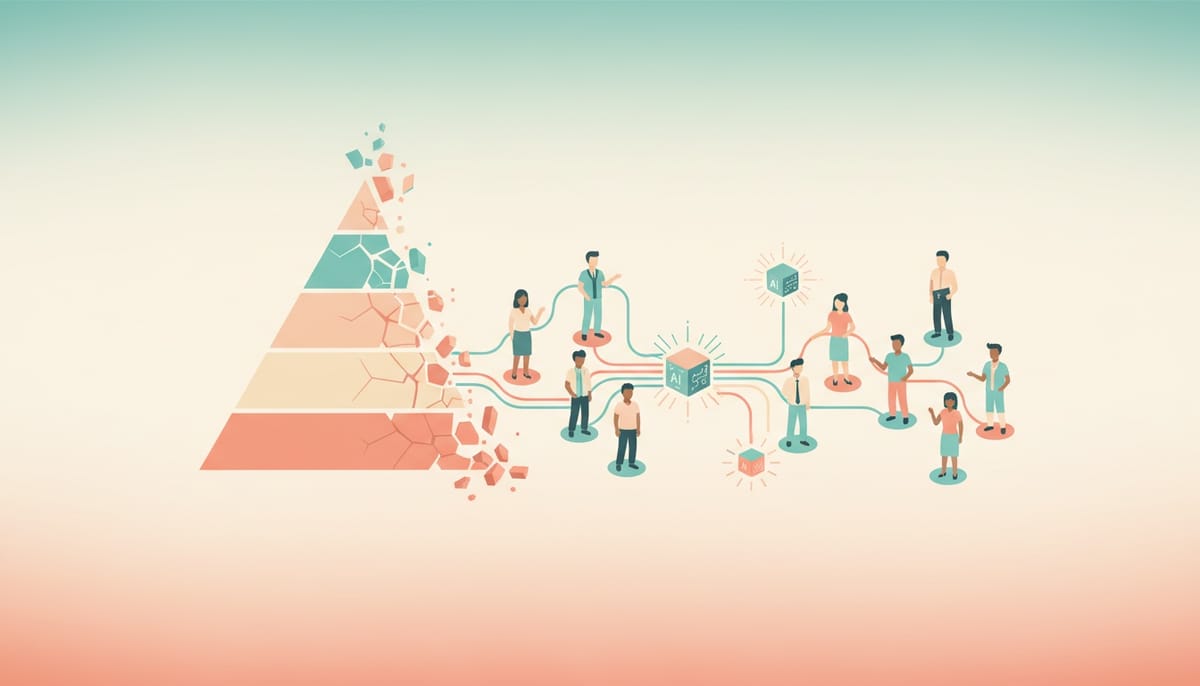
PwC just published a workforce report that should have gotten more attention. Their thesis: the hierarchical org chart pyramid — the one with executives at the top, middle managers in the middle, and individual contributors at the base — is being replaced by something flatter, weirder, and more interesting. They call it the "rise of the generalist."
The trigger? AI agents doing the work that used to justify middle management.
What the Pyramid Was Actually For
The modern org chart was designed around a specific problem: coordinating humans at scale. When you have 500 people, you cannot have 500 one-on-one conversations with the CEO. You need managers who coordinate teams, managers of managers who coordinate departments, and so on up the pyramid.
Most middle management work falls into four buckets:
- Status reporting (what is each person working on?)
- Coordination (who needs to talk to whom?)
- Escalation routing (when something breaks, who decides?)
- Performance oversight (is the work actually getting done?)
Here is what is happening in 2026: AI agents are taking over all four buckets. Not as a replacement, but as a structural change in who does that work.
The Case Data
PwC is not the only one seeing this. Gartner predicts 20% of organizations will use AI to flatten structures, eliminating more than half of middle management roles. Deloitte's research shows 72.9% of organizations are planning to use agentic AI to complement humans rather than replace them entirely. The pattern across reports is the same: individual contributors are staying, executives are staying, and the middle is getting restructured.
Look at what leading companies are doing:
- JPMorgan has 200,000 employees on their internal LLM suite, half of them using it 3+ times daily. That is 100,000 people with AI augmentation built into their daily workflow
- AMD deployed AI HR agents and saw an 80% reduction in time to resolve HR inquiries — a function that previously required multiple layers of HR managers
- McKinsey runs 20,000 AI agents alongside their 40,000 human consultants. A 1:2 ratio that did not exist 18 months ago
These are not pilots. These are production deployments changing what work looks like.
The Rise of the Generalist
PwC's core insight is that the people thriving in this transition are not hyper-specialists. They are generalists who combine domain expertise with AI orchestration.
A traditional marketing manager used to manage: copywriters, designers, social media managers, analytics people, and campaign coordinators. Five direct reports, maybe a dozen including their reports. Their job was coordination.
The AI-augmented marketing generalist in 2026 manages: a content AI, a design AI, a social scheduling AI, an analytics AI, and a campaign orchestration AI. Same functions, different team composition. They are still a generalist — they still need to understand strategy, brand, audience, and metrics — but they no longer spend their day in status meetings with five humans.
The difference is that the generalist now has execution leverage they never had before. What used to require a team of five can now be handled by one person managing five AI employees. That does not eliminate human jobs; it redistributes them. The people doing the actual specialized work (strategists, creatives, analysts, client managers) are still needed. The layer of coordinators between them and the outcomes? That is the layer getting thinner.
What This Looks Like in Practice
At smaller companies, this shift is already visible. A 10-person company in 2026 can deploy AI employees for customer support, content marketing, sales outreach, and administrative tasks. One person can effectively manage what would have required 3-4 hires three years ago.
At larger companies, the pattern is different. Entire departments are being restructured around "pods" of 2-3 generalists augmented by 8-10 AI agents. Project-based work is replacing role-based work. The question is no longer "what is your department" but "what is your outcome."
The companies doing this successfully share three characteristics:
- They started small. One specialist AI employee per function, not an enterprise-wide rollout
- They picked generalists to manage agents, not narrow specialists. The skill of orchestrating AI is closer to being a player-coach than being a deep individual contributor
- They measured outcomes, not activity. Tickets closed, deals moved, content shipped. Not hours worked
The Uncomfortable Middle
The uncomfortable part of this transition is for the people currently in middle management. Their job description is being automated function by function, even as their bosses still expect them to perform it.
The path forward for these professionals is the same path forward for the companies: embrace generalist augmentation. The middle managers who thrive will be the ones who add AI orchestration to their skill set. The ones who treat AI as a threat to their territory will find that territory shrinking.
This is not a prediction about 2030. It is the current state of the market. The companies restructuring around generalist-plus-AI are doing it right now. The ones still hiring traditional middle-manager roles are building organizations that will be uncompetitive in 18 months.
What Comes After the Pyramid
The post-pyramid organization is not flat in the "hold hands and sing" sense. It is flat in the sense that coordination happens through AI agents rather than human managers. Strategy still comes from executives. Specialized work still comes from experts. But the connective tissue between them — the status updates, the coordination meetings, the escalation routing — is handled by AI employees running 24/7.
PwC is right that the generalist is coming back. Not as a replacement for specialists, but as a new role entirely: someone who orchestrates a hybrid team of humans and AI to produce outcomes. This is not the death of management. It is the death of coordination as a full-time job.
Want to see what an AI-augmented generalist workflow actually looks like? Deploy your first AI employee in 5 minutes: Geta.Team