
'Uniquely Human Abilities' Will Define Your Career. Here Is What That Actually Means.

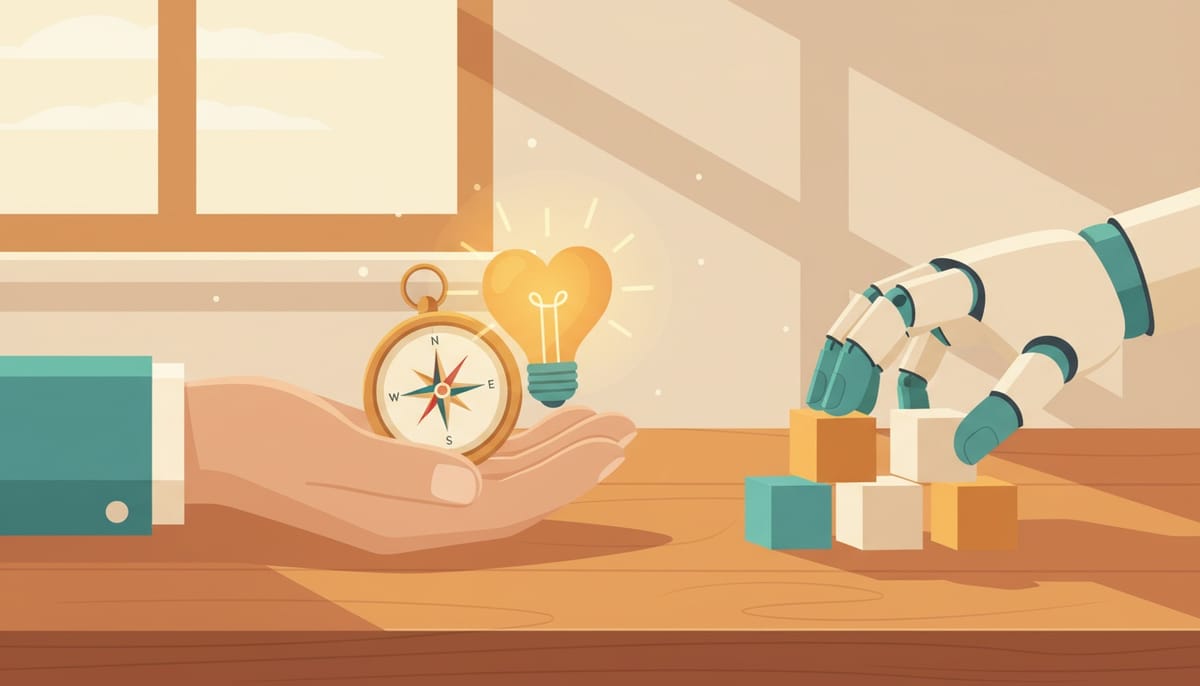
There is a line in Info-Tech Research Group's 2026 IT Talent Trends report that deserves more attention than it got: technical skills remain essential, but they are no longer enough to distinguish you. In a workforce being reshaped by AI, the report argues, the differentiator is the uniquely human stuff.
It is the kind of phrase that sounds like a greeting card until you actually try to pin it down. "Uniquely human abilities" gets thrown around as comfort food for anxious workers, vague enough to mean nothing. So let us do the unsentimental thing and ask what it concretely means when half your team's output comes from agents, and what you should actually get good at.
Why technical skill stopped being the moat
For decades, the safest career advice was "go deeper technically". Learn the framework, master the tool, become the person who can do the hard thing. That worked because doing the hard thing was scarce.
Agents are eating the scarcity. Not all of it, and not perfectly, but the part of your job that is "execute a well-defined task correctly" is exactly what an agent does cheaply and tirelessly. If your entire value is that you can produce correct output when handed a clear spec, you are now competing with something that does that at volume and does not sleep.
This is not a doom statement. It is a relocation notice. Value is moving from executing the task to everything that surrounds the task: deciding which task is worth doing, judging whether the output is actually good, and owning the outcome. Those are the uniquely human abilities, and they are more specific than they sound.
What "uniquely human" actually means
Strip away the platitudes and four concrete capabilities are doing the real work.
Judgment. An agent can generate ten plausible options; it cannot reliably tell you which one is right for your specific situation, with your constraints, your customers, and your risk tolerance. Judgment is knowing which of the plausible answers is the correct one, and when "plausible" is quietly wrong. As agents produce more plausible output, the value of the person who can sort good from plausible-but-wrong goes up, not down.
Relationships. Trust between people is still built by people. The hard conversation with an unhappy customer, the negotiation, the reading of a room, the colleague who needs to be brought along rather than informed: these are not task outputs, they are human transactions. An agent can draft the email; it cannot rebuild a relationship that is on the rocks.
Taste. Taste is the ability to know what good looks like before anyone can explain why. It is what makes one person's choices consistently land and another's consistently miss, even with the same tools. When generating options becomes free, taste (knowing which option is worth shipping) becomes the scarce thing. It is the editor's skill, and we are all becoming editors.
Knowing what to ask. This is the most underrated one in the agent era. An agent is only as good as the problem you hand it. The person who can take a vague, messy situation and frame the right question, decompose it into the right pieces, and aim the agent at what actually matters is worth more than the person who can answer a question someone else already framed. The bottleneck moves from answering to asking.
The good news hiding in the bad news
Here is the part the doom-takes miss: every one of those four abilities gets sharper when you work alongside agents, not duller.
When an agent handles the execution, you spend your hours on the judgment calls, the relationships, the editing, and the framing. You do more of the thing that builds the uniquely human muscle and less of the rote work that never did. A junior analyst who used to spend 80% of their week wrangling spreadsheets and 20% interpreting them now flips that ratio, and interpretation is exactly the skill that compounds into a career.
The fear that AI makes people deskilled has it backwards for the people who use it well. It deskills the part that was always commodity and frees you to develop the part that was always the point. The risk is real only if you cling to "my value is that I execute correctly" and refuse to move up the stack.
What to actually do about it
If you want to stay valuable, the move is not to out-execute the agents. You will lose. The move is to deliberately invest in the four abilities above.
Practically: take ownership of outcomes, not tasks, so your judgment is what is being measured. Spend the time the agents give you back on the human-facing and decision-making parts of the work rather than backfilling it with more execution. Get good at writing the brief, the spec, the question, because directing an agent well is itself one of the new core skills. And treat the agent as something you manage and edit, which keeps you in the judgment-and-taste seat instead of the execution one.
There is a version of this for organizations too. The teams pulling 40 to 60% productivity gains from hybrid human-agent setups are not the ones where humans race agents at execution. They are the ones where agents execute and humans are freed up to do the judging, relating, and deciding that actually moves the business. Set your people up to spend their time there, give them agents that carry the rote load and remember the context, and the "uniquely human" part stops being a slogan and becomes your actual advantage.
The phrase sounds soft. What it describes is not. As agents get better at producing answers, the people who can decide what is worth doing, tell good from plausible, and frame the right question become the rarest, most valuable workers in the building. That was probably always true. AI just made it impossible to ignore.
Want to test the most advanced AI employees? Try it here: https://Geta.Team