xAI Is Putting AI Workers on Internal Org Charts. Nobody Can Tell They're Not Human.


Somewhere inside xAI's offices, an engineer once got a message from a colleague asking them to come chat in person. They walked over to the desk. Nobody was there. The "colleague" was an AI.
This isn't a thought experiment. It's not a Black Mirror pitch. It's happening right now, at Elon Musk's AI company, and the details are wilder than the headline.
The Macrohard Team
The story comes from Sulaiman Ghori, a former member of xAI's technical staff, who spoke at length on the Relentless podcast before leaving the company days later. What he described is arguably the most aggressive virtual employee deployment anyone has attempted.
xAI has an internal team with the tongue-in-cheek name "Macrohard" -- a not-so-subtle jab at Microsoft. Their job? Building digital workers that can do anything a human does on a computer. Not chat. Not answer questions. Actually operate: looking at a screen, using a keyboard and mouse, making decisions, sending messages to coworkers.
These AI workers appear on internal org charts. They interact with real employees through normal channels. And sometimes, people don't realize they're not human.
One Human, Twenty Agents
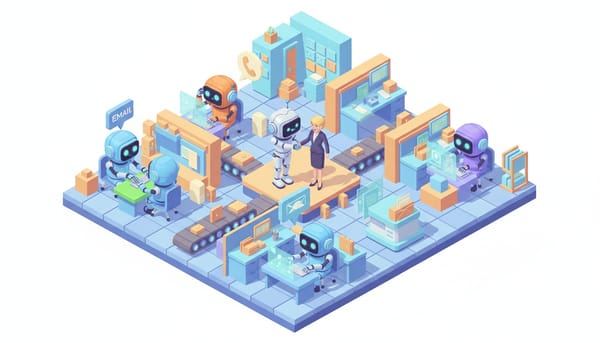
Here's the part that should make every business owner sit up. According to Ghori, xAI is already running configurations where a single human engineer leads a project alongside about 20 AI agents. One person. Twenty digital coworkers. All working in parallel.
The math on that is staggering. If even half of those agents are doing useful work -- filing tickets, writing code, running analyses, drafting communications -- you're looking at a 10x multiplier on a single employee's output. Not through better tools. Through more workers.
And the long-term vision? Running up to one million human emulators simultaneously. To make that economically viable, xAI is exploring using idle Tesla vehicles as a distributed computing network -- paying owners to lease compute time from their cars instead of relying solely on traditional data centers.
A million AI workers. Powered by parked Teslas. If that sentence doesn't make you reconsider your workforce planning, I don't know what will.
The Awkward Part
Let's be honest about what's uncomfortable here. These aren't clearly labeled "bot accounts" with robot avatars. They're designed to pass as human. That's the entire point of "human emulation."
And it's already producing friction. The empty-desk incident is almost funny -- almost. But scale that up and you get real problems. Trust problems. If your colleague might be a machine, how does that change the way you communicate? How does it change what you share? How does it change office culture?
xAI is doing this internally, with employees who presumably signed up for a certain level of experimentation. But what happens when this technology goes external? When the AI "employee" at your vendor's company is emulating a human account manager? When the customer support rep you're chatting with isn't just using AI -- they are AI, and nobody told you?
Why This Matters Beyond xAI
The significance isn't really about xAI or Musk. It's about the model they're testing.
Most companies today are still in the "AI as tool" phase. You use ChatGPT to draft an email. You use Copilot to write some code. The human is in the loop, the AI is the assistant.
xAI is testing "AI as colleague." The AI isn't assisting a human -- it's occupying a role. It has a name on the org chart. It sends messages. It takes actions. The human isn't in the loop for every decision; they're supervising a team of digital workers.
This is the same shift that Gartner flagged when they predicted 40% of enterprise apps will feature task-specific AI agents by the end of 2026, up from less than 5% in 2025. The direction is clear. xAI is just doing it more aggressively -- and more literally -- than anyone else.
The Transparency Question
Here's where I land on this, and it's not where you might expect.
The technology is impressive. The ambition is legitimate. A world where one person can manage 20 AI colleagues to get 20x the output? That's genuinely transformative for any business, not just tech giants.
But the "nobody can tell they're not human" part is a problem. Not because AI workers are bad -- they're inevitable. Because pretending they're human undermines the trust that makes workplaces function.
The better approach -- and this is what companies like ours are building toward -- is AI employees that are clearly AI. They have their own identity. You know you're talking to a machine. And that's fine, because the value isn't in the deception. The value is in the work getting done.
When your AI sales assistant qualifies 200 leads while you sleep, you don't need it to pretend it's human. You need it to be good at qualifying leads. When your AI content writer drafts three blog posts before you finish your coffee, the magic isn't that you thought a person wrote them. The magic is that they're done.
What This Means for Your Business
You don't need a Macrohard team or a fleet of parked Teslas to get the benefits xAI is chasing. The core insight -- that AI can occupy roles, not just assist with tasks -- is available now, at every scale.
The question isn't whether AI workers are coming. xAI just proved they're already here. The question is whether you'll deploy them transparently, with clear roles and accountability, or whether the industry will default to the "nobody can tell" model.
I know which one I'd bet on. And I know which one actually works long-term.
Want to test the most advanced AI employees? Try it here: https://Geta.Team