100 AI Agents for Every Employee: Inside Jensen Huang's $1 Trillion Vision


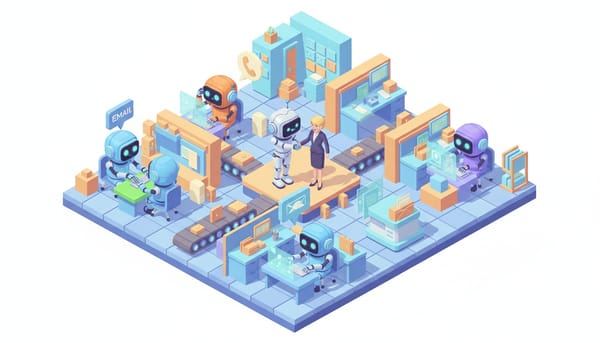
At NVIDIA GTC last week, Jensen Huang casually described a future where his company operates with 75,000 human employees and 7.5 million AI agents. That's 100 agents for every person. He didn't present it as a thought experiment. He presented it as a plan.
"Those 75,000 employees will be working with 7.5 million agents," he said during the Q&A. Not might. Will.
Here's what makes this more than a keynote soundbite: it's already happening. Not at the 100:1 ratio yet, but the trajectory is steep enough to take seriously.
McKinsey Is Already at 0.6:1
McKinsey's CEO Bob Sternfels revealed at CES 2026 that the firm now has 25,000 AI agents working alongside 40,000 human employees. That's a 0.6-to-1 ratio. Eighteen months ago, they had a few thousand.
Those agents saved McKinsey 1.5 million hours in search and synthesis work last year alone. Sternfels expects the firm to reach roughly equal numbers of agents and humans by the end of 2026.
McKinsey isn't some scrappy startup experimenting with AI. It's one of the most conservative institutions in business consulting. When McKinsey deploys 25,000 agents, it's not a pilot program. It's an operating model.
And they're not alone. Microsoft reported in February 2026 that 80% of Fortune 500 companies now use active AI agents. Gartner says 40% of enterprise applications will embed task-specific agents by the end of this year, up from less than 5% in 2025. That's an 8x jump in twelve months.
The Token Salary
The most revealing thing Huang said at GTC wasn't the 100:1 ratio. It was this:
"Every single engineer in our company will need an annual token budget. They're gonna make a few hundred thousand dollars a year their base pay. I'm gonna give them probably half of that on top of it as tokens so that they could be amplified 10x."
Read that again. NVIDIA plans to pay engineers an additional $100,000 to $150,000 per year — not in stock, not in bonuses, but in AI compute credits. Token budgets as a line item on your compensation package.
This is a leading indicator of something much bigger than headcount reduction. It's the birth of a new cost center: agent infrastructure as a standard operating expense. When companies start budgeting tokens alongside salaries, the agent-to-human ratio stops being theoretical and starts showing up in quarterly earnings.
Huang called tokens "one of the recruiting tools in Silicon Valley." Investors estimate inference costs could form over 20% of total engineer compensation packages. The message is clear: your ability to orchestrate agents is becoming as valuable as your ability to write code.
The Cautionary Tale
Before this starts sounding like pure hype, it's worth looking at what happens when you move too fast.
Klarna deployed an AI system that handled the equivalent work of 850 customer service agents. It processed 2.3 million conversations across 35 languages and handled 75% of all customer chats. The company cut its workforce from 5,500 to 3,400.
Then quality tanked. CEO Sebastian Siemiatkowski publicly admitted they "went too far." Klarna is now rehiring humans for premium support, treating human interaction as "VIP treatment."
The lesson isn't that agents don't work. The lesson is that raw replacement — swapping humans for agents without rethinking the workflow — fails. The companies getting this right aren't firing everyone and replacing them with bots. They're building hybrid teams where agents handle volume and humans handle judgment.
Which is exactly what Huang is describing. His 100:1 vision isn't 100 agents replacing 100 humans. It's 100 agents amplifying one human. That's a fundamentally different proposition.
What 100:1 Actually Looks Like
Forget the dystopian framing for a second. Think about what your day would look like if you had 100 agents working for you.
Ten agents monitoring your industry — scanning news, competitor moves, regulatory changes, social media mentions — and synthesizing a daily brief before you start work. Five agents managing your inbox, triaging by priority, drafting responses, flagging what needs your direct attention. Twenty agents running your CRM — qualifying leads, scheduling follow-ups, updating deal stages, generating pipeline reports. Fifteen agents handling customer support — resolving tier-1 issues, escalating complex cases, tracking satisfaction scores. The rest doing everything from content creation to financial reconciliation to vendor management.
You're not managing 100 employees. You're managing 100 processes. The agents don't need motivation, PTO, or performance reviews. They need clear instructions, good tools, and guardrails.
This is why NVIDIA built OpenShell at GTC — an open-source runtime with sandboxing, policy enforcement, and privacy controls specifically for autonomous agents. They're building the infrastructure to make 100:1 safe, not just possible.
Where This Leaves Everyone Else
Here's the uncomfortable part. If McKinsey is at 0.6:1 today and heading toward 1:1 by year-end, the gap between companies that are deploying agents and companies that are still "evaluating AI" is about to become a chasm.
Gartner warns that over 40% of agentic AI projects will be canceled by 2027 — not because the technology fails, but because companies lack governance frameworks. The companies that win won't be the ones that deploy agents fastest. They'll be the ones that deploy them with the right structure: clear roles, persistent memory, real tool access, and human oversight where it matters.
Huang said every company needs to become an "AaaS company" — agentic as a service. That sounds like marketing speak until you realize he's describing the same transition that happened with cloud computing. First it was optional. Then it was competitive. Then it was table stakes.
We're somewhere between competitive and table stakes right now.
The Bottom Line
Jensen Huang's 100:1 ratio isn't a prediction about 2036. It's a trajectory that started in 2025 and is accelerating faster than most people realize. McKinsey has 25,000 agents today. 80% of Fortune 500 companies are running active agents. Enterprise apps with embedded agents are jumping from 5% to 40% in a single year.
The question isn't whether your company will have AI agents. It's how many, how soon, and whether you'll build the right team structure around them before your competitors do.
Want to test the most advanced AI employees? Try it here: https://Geta.Team