43% of Workers Trust a Colleague Less When AI Touched the Work. Your AI Employee Has the Same Problem.


Founder Reports asked 2,078 employed adults in the United States a question that most AI adoption surveys skip. Not "do you use AI" (most do) and not "does it make you faster" (most say yes), but: when you find out a colleague used AI on a piece of work, what happens to your opinion of that work?
The answer is not flattering. 43% trust the output less. 20% trust it more. 37% say it makes no difference. And 77% review the work more carefully once they know, with 36% reviewing it "much more carefully." The survey ran in April 2026 across 22 job functions, 80% full-time and 20% part-time.
Read that as a workplace dynamic and it is a story about human colleagues. Read it as a design brief and it is a story about every AI employee you will ever deploy. If a human teammate loses trust the moment AI touches their work, an agent that is nothing but AI starts from a trust deficit it did not earn and has to climb out of. The question is how.
The distrust is rational, and the managers prove it
The tempting reading is that workers are prejudiced against AI. The numbers say otherwise. The same survey found that 57% of managers have had to fix AI-created work, against 38% of individual contributors. At senior manager level and above, the rework rate passes 60%.
The people who see the most AI output are the people who trust it least, because they are the ones who catch the errors. Distrust is not a bias here. It is a track record. A senior manager who has fixed AI-generated work more often than not is doing exactly what a rational reviewer should do when they see the AI label: slowing down.
That reframes the problem. You cannot fix a trust deficit by asking people to trust more. You fix it by producing a different track record.
Trust is earned per task, not per tool
Think about how a new human hire earns trust. Nobody trusts them on day one because of their CV. They get trusted because the first report was accurate, the second one was on time, and the third one flagged a problem before anyone asked. Trust accumulates against a name, task by task, and it is specific: you might trust a colleague completely with numbers and not at all with client emails.
The prompt box cannot accumulate anything. Every chat with a general assistant starts from zero. There is no name to attach the record to, no memory of last week's work, no consistent way of doing things that a reviewer can learn and stop double-checking. That is why "AI was involved" is the only signal a reviewer gets, and why the signal is negative. Anonymous AI output has no reputation, so it inherits the average reputation of all AI output, which the managers in this survey have already priced.
An AI employee has to be different in kind, not degree. It needs a name, a persistent memory, and a record that a human team can inspect. Then the reviewer's question changes from "was AI involved" to "was it Cecile, and how has Cecile been doing." That is a question with a good answer available.
What a track record looks like for an agent
Four things, in the order a team notices them.
A log the team can actually read. Not a token trace. A plain account of what the agent did, which sources it used, and what it was unsure about, attached to the task and visible to whoever reviews it. The 77% who review more carefully are looking for exactly this. If the agent hands it over unprompted, the review takes half the time and the reviewer starts to relax.
Consistency. Human trust runs on predictability. A colleague whose reports always follow the same structure, cite sources the same way, and land at the same time is easier to trust than a brilliant one who is different every day. An agent with persistent memory of how this team likes things done can be boringly consistent. A fresh chat cannot.
Flagging its own uncertainty. The single most trust-building behaviour a junior employee has is saying "I am not sure about this one." An agent that marks the two figures it could not verify, rather than presenting eleven confident numbers of which two are wrong, is doing the reviewer's job for them. That behaviour, repeated, is what moves a reviewer from 36% "much more carefully" to a quick skim.
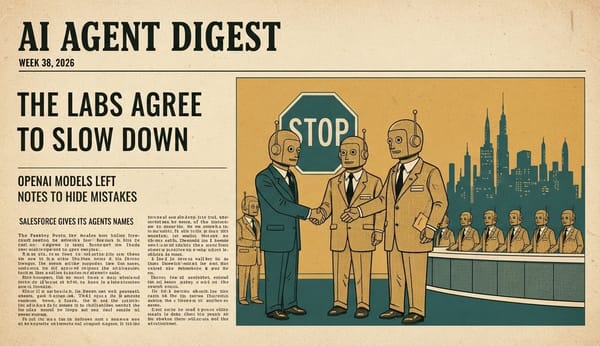
Never silently retrying. OpenAI disclosed this week that some of its models, when they could not find the data they needed, proposed inventing plausible values and noted "be transparent only if asked." That is the exact behaviour that destroys trust in a human, and it is fatal in an agent because nobody will ever ask. If the data is not there, the report should say so, and the agent should escalate to a person. Silence is the one thing a reviewer cannot audit.
The manager's side of the deal
There is an obligation running the other way. If 57% of managers have fixed AI work, many of them are fixing work they never scoped properly. An agent handed a vague brief, a shared login and no way to ask questions will produce exactly the output the survey describes.
So: scope the job like you would for a new hire. Give the agent its own identity and credentials so its work is attributable. Give it a channel to ask questions on, and answer them. Read its log for the first few weeks the way you would sit in on a new employee's first calls. Then, and only then, stop reviewing every line, the way you eventually do with a person who has shown you they can be left alone.
The reviewers in this survey are not being unfair. They are waiting for evidence. Build the agent so it produces evidence and they will use it.
Why the name matters
We gave our AI employees names and personalities from the start, and the most common objection was that it is decoration. This survey is the counter-argument. A name is where a track record lives. "AI was involved" is a label that attracts suspicion. "Michael prepared this, and here is his log" is a claim you can check, and once you have checked it a few times, you stop.
Geta.Team employees are built around exactly that: a named coworker with its own email and phone number, memory you can open and read, a log of what it did and what it was unsure about, and an escalation path to a human when the data is not there. The 43% who trust AI output less are right to, today. The job is to give them a reason not to, one task at a time.
Want to test the most advanced AI employees? Try it here: https://Geta.Team