
AgentCore Tasks Grew 15x in Six Months. Agents Quietly Crossed Into Production.

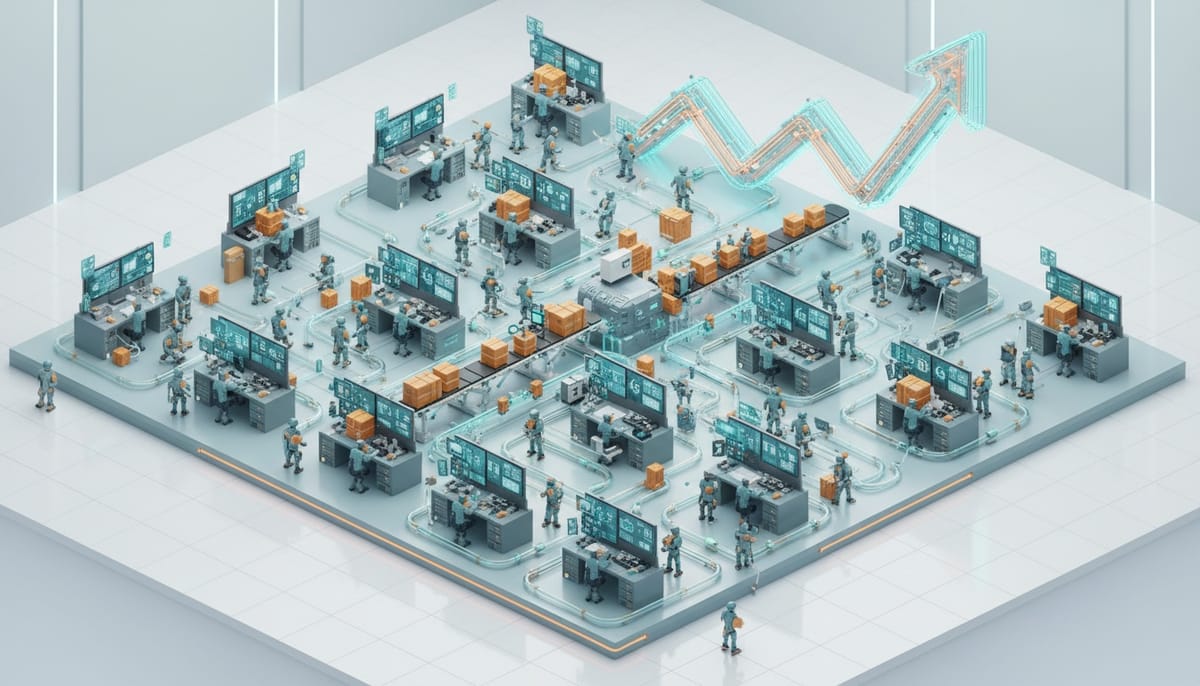
Here is a number worth sitting with. In the past six months, the volume of tasks performed by agents on Amazon's AgentCore grew fifteen times over. Not fifteen percent. Fifteen times. AWS dropped that figure at its New York Summit alongside a roster of names that do not experiment in public: Nasdaq, Visa, and Experian are scaling agents across their enterprises, and the PGA Tour is now writing tournament coverage ten times faster than before (AWS).
For most of the last two years, the honest answer to "are companies really using AI agents, or just demoing them" was a shrug. The demos were everywhere. The production deployments were rumored. A 15x growth curve on a single platform, with banks and card networks attached to it, is the closest thing to a definitive answer we have gotten. The pilot era is over. This is what the other side looks like.
What a 15x curve actually tells you
Growth like that does not come from people trying agents. It comes from people trusting them with the next task, and the next one after that. You do not run fifteen times the agent workload because a demo impressed you. You run it because the first batch worked, did not embarrass you, and freed up enough time that you went looking for more to hand over. Fifteen-x is the signature of a tool that crossed from novelty into dependency.
The names matter as much as the number. Nasdaq, Visa, and Experian are not lighthouse logos that signed up for a press release. They are some of the most regulated, risk-averse, audited organizations on earth. A card network does not scale agents across its enterprise on a hunch. When institutions whose entire business is not making mistakes start handing work to agents at scale, the question has clearly shifted from "does this work" to "how much can we move."
And the PGA Tour detail is the one I would not skip past, because it is the most relatable. Writing tournament coverage ten times faster is not a back-office efficiency. It is a creative, deadline-bound, public-facing job being done by an agent and shipped to real audiences. That is the kind of work everyone insisted would stay human longest, getting agentized in production right now.
Why now, and not a year ago
The thing that changed is not the models. It is the scaffolding around them. For a long time, the gap between an impressive agent demo and a dependable production agent was enormous, and it had nothing to do with intelligence. It was everything else: how the agent holds state, how it authenticates, how you watch what it does, how you stop it, how you recover when it goes wrong.
That is the layer that matured this year, and it is the same layer the whole market is now pouring money into. A 15x usage curve is what happens when the infrastructure finally catches up to the capability. The agents were smart enough eighteen months ago. They were not yet safe enough, observable enough, or governable enough to trust with real volume. Now, for a growing set of tasks, they are.
The trap in the big numbers
It would be easy to read all this as a story about giants. Nasdaq has a budget you do not. Visa has a security team larger than your whole company. If the lesson is "the Fortune 100 is scaling agents," that is interesting and useless to a business with twelve people.
But that is not the lesson. The reason those organizations can scale agents is not that they are big. It is that they finally have agents they can identify, scope, observe, and audit. Strip away the budget and that is a list of properties, not a list of resources, and properties are available to anyone who insists on them. The 15x curve at Visa and the first agent at a small business are the same bet made at different scales: hand work to something you can actually supervise.
What the early movers prove is not that you need to be enormous. It is that the production-readiness checklist is real, and it is the thing that separates an agent you scale from an agent you quietly turn off after a month. Does it have its own identity, or is it borrowing a human's? Can you see what it did, after the fact, in a log you trust? Can you scope it to exactly the task and stop it cleanly? Does the work it produces meet your bar without a person redoing it?
The same bet, at your scale
This is the whole reason we build Geta.Team the way we do. The properties that let Visa scale agents are not exotic enterprise features. They are the baseline: AI employees with their own scoped identity, an auditable record of every action, persistent memory so they actually get better at your work instead of starting cold each time, and self-hosted deployment so the data and the decisions stay yours. Those are not things you bolt on once you reach Nasdaq's size. They are the things that let a five-person company run its first agent with the same confidence a card network runs its thousandth.
A 15x growth curve is a milestone for the category, but it is also an invitation. The early movers did the expensive work of proving agents survive contact with regulated, public, high-stakes production. The path they cleared is now open to everyone behind them, and the entry requirement is not scale. It is trust you can verify.
The pilot era is over. The only question left is which agents you will actually let cross into production, and whether you can prove, on any given day, exactly what they did.
Want to test the most advanced AI employees? Try it here: https://Geta.Team