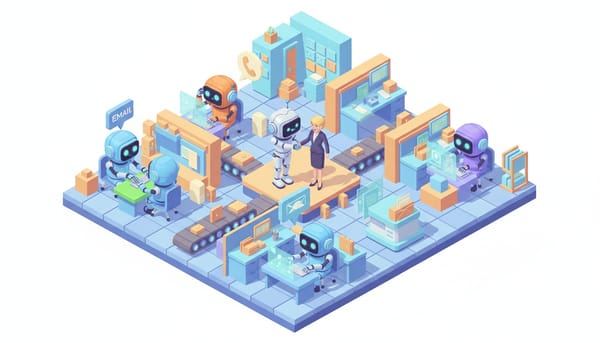
B2A Is Going to Be Bigger Than B2B


Every SaaS product you use was designed for a human. A human who clicks buttons, reads dashboards, fills out forms, and solves CAPTCHAs. That assumption is about to age very badly.
AI agents are becoming the primary users of software. Not as a futuristic thought experiment — right now, today, at scale. Google Cloud reports that 52% of enterprise executives have deployed AI agents in production. Gartner predicts that by 2028, 90% of B2B purchasing will be intermediated by AI agents. Mastercard and Santander just completed Europe's first live end-to-end payment executed entirely by an AI agent.
The shift from B2C to B2B reshaped entire industries. The next shift — B2A, Business to Agents — is going to be even bigger.
What B2A Actually Means
B2A is not a buzzword. It is a concrete market shift where your next power user is not a person scrolling your website. It is your customer's AI agent — booking flights, evaluating vendors, restocking inventory, processing invoices — all autonomously, all on behalf of a human who never touches your product directly.
Y Combinator has already placed its bet. Over 50% of their Spring 2025 batch focused on agentic AI, and they explicitly stated they want to invest in companies that provide services directly to AI agents rather than to the humans behind them. When YC moves, the market tends to follow.
The numbers behind this are staggering. Gartner projects $15 trillion in B2B purchases will be AI-agent-intermediated by 2028. McKinsey estimates $3-5 trillion in global agentic commerce by 2030. Morgan Stanley puts the US e-commerce figure alone at $190-385 billion via agentic shoppers by the end of the decade.
This is not incremental growth. This is a category-defining shift.
The Infrastructure That Doesn't Exist Yet
Here is the problem: nearly all software is still designed for humans. And agents need something fundamentally different.
Agents need APIs, not dashboards. A dashboard is visual chrome for human brains. An agent needs clean, well-documented, machine-readable endpoints. Yet only 24% of developers currently design APIs with AI agent consumption in mind. That is a massive gap between where we are and where we need to be.
Agents need payment rails, not credit card forms. You cannot ask an AI agent to click "Add to Cart" and type in a CVV. Three competing protocols are racing to solve this: OpenAI's Agentic Commerce Protocol (ACP), Google's Agent Payments Protocol (AP2) with 60+ partners including Mastercard and PayPal, and Coinbase's x402 protocol for stablecoin micropayments. Mastercard's Agent Pay is already live across all US cardholders. Stripe has shipped an Agent Toolkit. The payment infrastructure is being built — fast.
Agents need identity, not CAPTCHAs. Before an agent can transact on your behalf, it needs verifiable identity. NIST has published a concept paper on identity and authorization controls for AI agents. Skyfire built a Know Your Agent (KYA) framework. An Agent Name Service (ANS) has been proposed as an IETF standard — essentially DNS for agents, mapping identities to verified capabilities and cryptographic keys.
Agents need memory, not session cookies. A human re-learns the interface every visit. An agent should remember your preferences, your purchase history, your constraints. AWS Bedrock now offers managed agent memory. Mem0 has 35,000+ GitHub stars building an open-source memory layer. Redis, MongoDB, and OpenSearch have all shipped agent memory infrastructure.
Agents need protocols, not phone trees. Google's A2A (Agent-to-Agent) protocol, now housed under the Linux Foundation alongside Anthropic's MCP, enables agents to discover, communicate, and collaborate regardless of their underlying framework. The Agentic AI Foundation — backed by AWS, Anthropic, Google, Microsoft, OpenAI, and Cloudflare — is standardising the communication layer for the entire agent economy.
The B2A Stack Is Being Built Right Now
If you squint, you can see the full B2A infrastructure stack emerging:
- Communication layer: A2A, MCP, AGENTS.md
- Payment layer: Mastercard Agent Pay, Visa Trusted Agent Protocol, AP2, ACP, x402
- Identity layer: KYA, Agent Name Service, NIST frameworks
- Memory layer: Mem0, AWS Bedrock AgentCore, Redis, OpenSearch
- API/Documentation layer: Google Developer Knowledge API, Postman's AI-Ready APIs
- Governance layer: EU AI Act, Galileo Agent Control, Cloud Security Alliance frameworks
Every one of these layers was either nonexistent or experimental twelve months ago. Today, they are backed by the largest technology and financial companies in the world.
What This Means for Your Business
If your product still assumes a human is on the other side of the screen, you are building for a shrinking audience.
Kantar frames B2A as comparable to the mobile disruption of 2010 — and estimates it could rewrite category market shares within 18-24 months. Two-thirds of B2B buyers already rely on AI agents as much as or more than Google when evaluating vendors. If your product is not agent-readable, agent-accessible, and agent-transactable, you are invisible to the fastest-growing segment of "users" in the market.
The companies that build agent-native products first will own entire categories. The rest will wonder what happened — the same way brick-and-mortar retailers wondered what happened when e-commerce ate their lunch.
Where Geta.Team Fits
At Geta.Team, we have been building AI employees — not chatbots, not copilots, but autonomous agents that execute real work — since before B2A had a name. Our agents already have persistent memory, their own email and phone number, the ability to create custom skills on demand, and the autonomy to operate 24/7.
The B2A wave is not something we are preparing for. It is something we have been shipping.
Want to see what an AI employee actually looks like in practice? Try it here: https://Geta.Team