CES 2026 Proved Physical AI Is Here. Your Next AI Employee Might Have Hands.

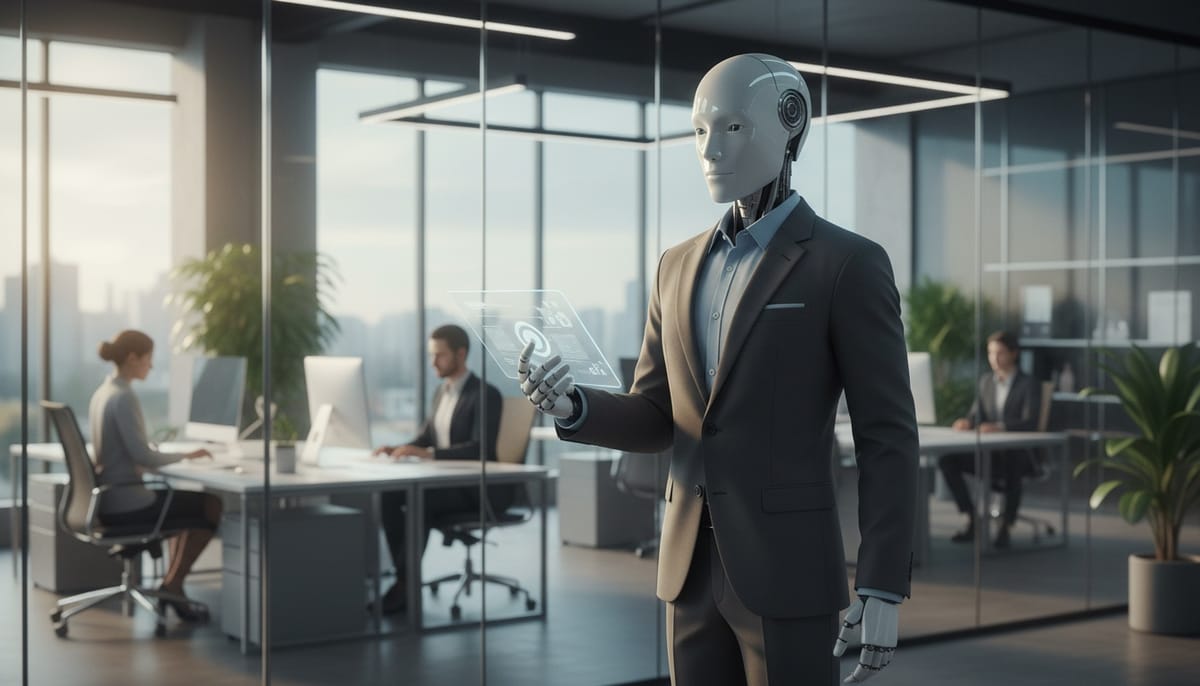
Two days ago, a 6-foot-2 humanoid robot walked across a stage in Las Vegas and lifted 110 pounds while an audience of 4,000 tech executives applauded.
That robot was Atlas, built by Boston Dynamics (owned by Hyundai), and it wasn't a prototype. It was production-ready. All 2026 units are already sold out. Hyundai plans to manufacture 30,000 of them per year by 2028.
Meanwhile, at the same event, Lenovo unveiled Qira—a "personal AI super agent" that perceives your context across devices, remembers your preferences, and acts on your behalf. It's rolling out in Q1 2026.
CES 2026 made one thing clear: the era of AI agents that only exist as software is ending. Physical AI is here.
The Convergence Nobody Saw Coming
For the past two years, we've talked about AI employees as digital entities. They live in your inbox, your Slack, your CRM. They schedule meetings, draft emails, analyze data, and handle customer support. No body required.
But the companies betting billions on AI's future see something different. They see a world where digital intelligence and physical capability merge.
Hyundai isn't investing $87 billion in AI just to build chatbots. They're building robots that will assemble cars, move inventory, and work alongside humans in factories by 2030. Boston Dynamics just partnered with Google DeepMind to give Atlas "greater cognitive capabilities"—essentially, the brains of an AI agent inside a body that can lift, carry, and manipulate objects.
Lenovo's approach is different but complementary. Qira isn't a robot—it's ambient intelligence that follows you across your laptop, phone, tablet, and wearables. It builds what they call "a living model of your world" and can orchestrate actions across devices without you managing every step.
One company is giving AI a body. The other is giving it presence across every screen you own. Both are heading toward the same destination.
What This Means for Business AI
If you're running a business and thinking about AI employees, the CES announcements might seem like science fiction. You're not about to deploy humanoid robots in your office.
But here's what matters: the same AI architectures powering physical robots are the ones powering your virtual assistants. The ability to perceive context, plan multi-step actions, use tools, and operate autonomously—that's the foundation of both.
The difference is just the output layer. A digital AI employee sends an email. A physical AI employee picks up a package. The "thinking" underneath is converging.
This has practical implications:
Skill transferability: AI systems trained for physical tasks are developing capabilities that transfer to digital work. Google DeepMind's work on robot cognition improves the planning and reasoning abilities of all their AI models.
Multi-modal understanding: Robots need to see, hear, and understand their environment. This pushes AI development toward systems that can process video, interpret spatial relationships, and understand context from multiple inputs. Those same capabilities make your AI customer support agent better at understanding screenshots, reading documents, and interpreting user intent.
Autonomous action: The hardest problem in AI isn't generating text—it's taking reliable action in the real world. Every advance in robot autonomy translates to AI agents that can execute more complex digital workflows without constant supervision.
The 2028 Timeline
Based on CES announcements, here's what the next few years look like:
2026: Lenovo Qira ships on consumer devices. Boston Dynamics deploys Atlas to Hyundai's robotics research centers and Google DeepMind. AI agents become standard in enterprise applications (Gartner predicts 40% penetration).
2027: First Atlas deployments in actual factory workflows for simple tasks like parts sequencing. Cross-device AI agents (like Qira) become the expected interface for knowledge work.
2028: Hyundai's Georgia Metaplant begins producing 30,000 Atlas robots per year. Atlas units start assembling vehicle components. The line between "digital employee" and "physical employee" starts to blur.
2030: Hyundai's stated goal—Atlas robots handling complex assembly work requiring repetitive motions and heavy lifting. By this point, the AI running a factory robot and the AI managing your calendar share more architecture than they differ.
What Should You Do Now?
If physical AI feels far away, that's because it is—for most businesses. You're not going to buy a humanoid robot in 2026.
But you can get ahead of the convergence:
Start with digital AI employees now. The organizations that will integrate physical AI smoothly are the ones that already understand how to work with AI colleagues. They've figured out task delegation, quality control, and human-AI handoffs. Those skills transfer directly.
Choose AI systems designed for autonomy. Not all AI tools are created equal. Some are glorified chatbots. Others are built for genuine autonomous operation—with memory, planning, and multi-step execution. The latter are the ones building toward the physical AI future.
Think roles, not tools. The framing matters. "AI that helps with email" is a tool. "AI executive assistant that owns calendar, travel, and correspondence" is a role. Physical AI will work the same way—not "robot that moves boxes" but "warehouse coordinator that manages inventory flow."
The Punchline
Your next AI employee might have hands. Not in 2026, probably not in 2027, but the trajectory is clear.
The smart play isn't to wait for robots. It's to build your AI workforce now—with digital employees that handle the work that doesn't require a body—so that when physical AI becomes practical, you already know how to manage AI colleagues.
The organizations treating AI as a workforce multiplier today will be the ones adding physical AI seamlessly tomorrow. The ones still debating whether to "try ChatGPT" will be the ones scrambling to catch up.
CES 2026 wasn't just a tech show. It was a preview of the 2030 workforce.
Want to test the most advanced AI employees? Try it here: https://Geta.Team