How AI Agents Are Changing Cybersecurity: From 5-Day Scans to 1 Hour

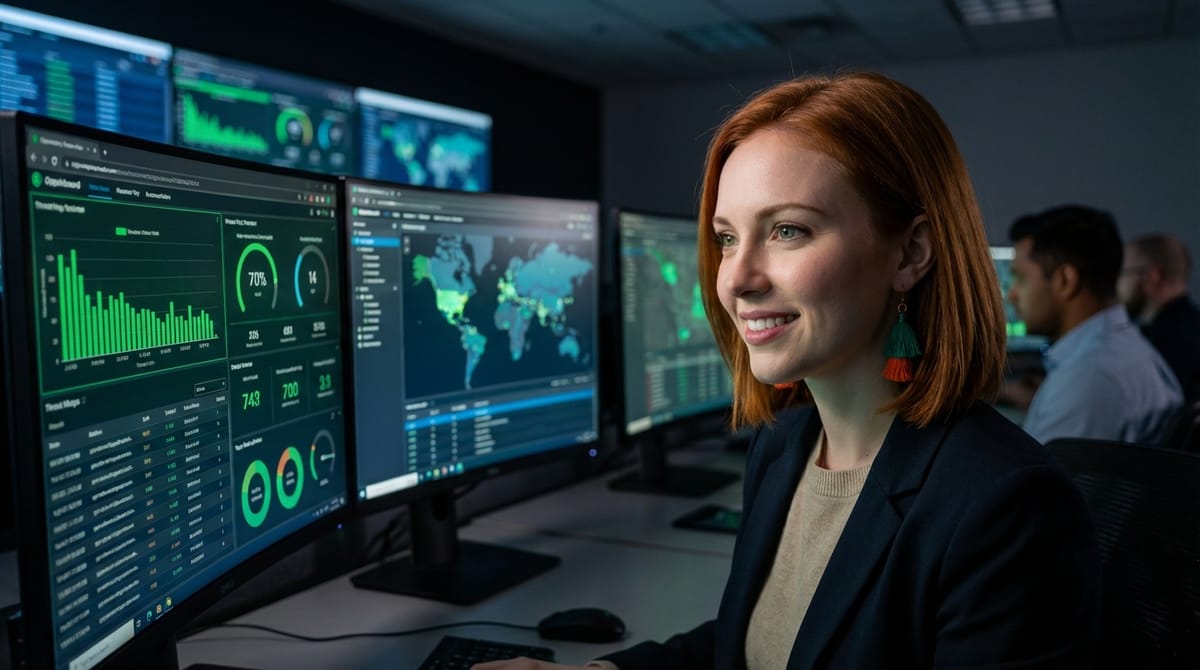
Security operations centers have a dirty secret: most of them are drowning.
The average enterprise SOC receives thousands of alerts per day. Analysts triage maybe 10% of them manually. The rest? Logged, ignored, or auto-closed by rules that were written two years ago for a threat landscape that no longer exists. Vulnerability scans take 3-5 days to complete. By the time a report lands on someone's desk, the attacker has already moved.
This isn't a people problem. It's a speed problem. And at RSA Conference 2026 last week, the cybersecurity industry collectively decided that AI agents are the answer.
The Accenture-Anthropic Play
The headline announcement was Cyber.AI — a joint solution from Accenture and Anthropic that puts Claude at the center of enterprise security operations.
The pitch: transform cybersecurity from human-speed, reactive firefighting into continuous, AI-driven defense. Claude serves as the reasoning engine — synthesizing security data across the entire lifecycle, running autonomous workflows for analysis, triage, remediation, and threat hunting.
The numbers from Accenture's own internal deployment are hard to ignore:
- Scan turnaround: 3-5 days down to under 1 hour
- Security testing coverage: ~10% up to over 80%
- Service delivery: 35% improvement
- Scope: 1,600 applications, 500,000+ APIs secured
Damon McDougald, Accenture's Global Cybersecurity Services Lead, framed it bluntly: "Adversaries are using AI to compress attack timelines from weeks to hours, while traditional controls are built for human-speed threats."
He's right. When attackers can probe thousands of endpoints in minutes using their own AI agents, a SOC that takes three days to finish a vulnerability scan is bringing a clipboard to a gunfight.
Agent Shield: Governing the Governors
The most interesting part of Cyber.AI isn't the automation — it's the governance layer called Agent Shield.
Here's the uncomfortable truth about deploying AI agents in security: the agents themselves become attack surfaces. An autonomous agent with broad permissions that can access sensitive systems, execute commands, and make decisions at machine speed is exactly the kind of thing that makes security teams nervous. For good reason.
Agent Shield addresses this by providing:
- Identity controls for autonomous agents (treating them as managed identities, not just API tokens)
- Runtime protection that keeps agents within defined authority boundaries
- Real-time behavioral monitoring for anomalies in agent behavior
- Policy enforcement ensuring agents adhere to organizational risk tolerance
This matters because the governance gap in agentic AI is enormous. According to the World Economic Forum's Global Cyber Outlook 2026, nearly 90% of organizations identify AI-related vulnerabilities as their fastest-growing cyber risk. Yet only 6% have an advanced AI security strategy in place.
Agents defending you need to be defended themselves. Agent Shield is one of the first serious attempts to operationalize that idea.
Everyone Else Got the Memo Too
Accenture and Anthropic weren't alone at RSA. The entire cybersecurity industry pivoted to agents simultaneously:
CrowdStrike launched Charlotte AI AgentWorks — an ecosystem for building secure agents across detection and response. Their CEO George Kurtz positioned the endpoint as "where AI takes place."
Cisco and Splunk unveiled six specialized AI agents: Detection Builder, Triage Agent, Malware Threat Reversing Agent, Guided Response Agent, and more. They also announced Zero Trust Access for AI Agents — identity management and policy enforcement specifically for non-human entities. A telling stat from their announcement: 85% of Cisco enterprise customers are experimenting with AI agents, but only 5% are in production. The gap between experimentation and deployment is still massive.
Palo Alto Networks released Prisma AIRS 3.0 for discovering and assessing AI agent activities across cloud, SaaS, and endpoint environments — plus an upcoming AI Agent Gateway to secure agent-to-agent communication.
Arctic Wolf went the furthest with Aurora Agentic SOC — a fully autonomous security operations center powered by agent swarms and a proprietary knowledge graph. They're processing over 10 trillion cybersecurity events weekly.
And then there's Amazon, which revealed autonomous security agents evolved from an internal hackathon project. Their Autonomous Threat Analysis system uses competing red/blue team AI squads — testing 200+ hacking methods in 90 minutes (versus weeks traditionally) with a 100% detection rate for Python reverse shell attacks. The agents can even generate and validate patches autonomously in sandboxed environments.
The Dual-Use Problem Nobody Wants to Talk About
Here's what makes AI agents in cybersecurity fundamentally different from AI agents doing, say, customer support: the technology is simultaneously the weapon and the shield.
A Dark Reading poll found that 48% of cybersecurity professionals now identify agentic AI as the single most dangerous attack vector. Not phishing. Not ransomware. AI agents.
The threat surface is specific and growing:
- Prompt injection — manipulating an agent's reasoning through crafted inputs
- Tool misuse — agents with access to powerful tools executing unintended actions
- Privilege escalation — agents inheriting overly broad permissions
- Memory poisoning — corrupting an agent's persistent context to influence future decisions
- Cascading failures — one compromised agent spreading bad decisions through a multi-agent system
Most agents today still inherit broad permissions with no zero-trust boundaries governing their reach. When a security agent has access to your entire cloud infrastructure — because it needs to, to do its job — the blast radius of a compromise is everything.
This is why Agent Shield-style governance isn't optional. It's the prerequisite for the whole approach working.
What This Actually Means
The numbers tell the story of where things are heading:
- 52% of executives in AI-using organizations already have agents in production
- 46% have adopted agents specifically for security operations
- 35% anticipate AI agents will replace Tier-1 SOC analysts entirely
- Security budgets for AI solutions are expected to triple — from ~4% to 15% of total spend
But the honest take is this: we're in the early innings of a transition where AI agents go from "interesting experiment" to "load-bearing infrastructure" in cybersecurity. The companies that deploy agents with proper governance — identity management, behavioral monitoring, least-privilege access, human-in-the-loop for irreversible actions — will pull ahead. The ones that deploy agents without those guardrails will become the cautionary tales.
The scan went from 5 days to 1 hour. That's the headline. The real story is whether we can govern the thing that made it possible.
Want to test the most advanced AI employees? Try it here: https://Geta.Team