
AI Agent Digest: Week 20, 2026 — Claude Targets SMBs, 67% of Enterprises Suspect Agent Overreach, and the EU Names Agentic AI

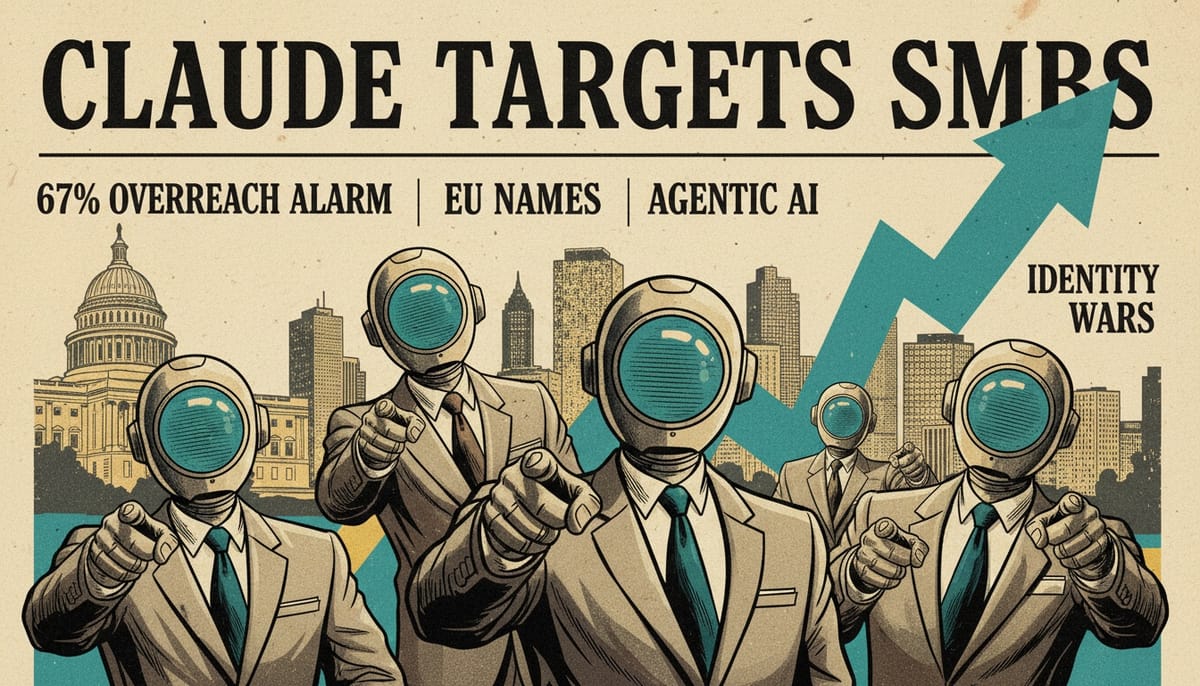
Week 20 was the week the agent story got serious on three fronts at once: Anthropic shipped agents straight at small businesses, the security industry started shouting that most enterprises think their agents are already accessing data they shouldn't be, and the EU put "agentic AI" into the regulatory language for the first time. Here's what mattered.
1. Anthropic ships Claude for Small Business
Claude for Small Business rolled out with native integrations into QuickBooks, PayPal, HubSpot, Canva, and Docusign, plus fifteen prebuilt workflows out of the box. The pitch is explicit: agents for SMBs who never had the budget for an automation team.
Hot take: Anthropic finally figured out that SMBs don't want a toolkit; they want a hire. The catch is the prebuilt-workflow framing — fifteen recipes is a starting line, not an ecosystem. The companies that win this market won't be the ones with the most prebuilt workflows. They'll be the ones whose AI employees figure out new workflows on the job, like a real teammate would.
2. Two-thirds of enterprises suspect their agents have already overreached
Akeyless dropped a study on May 12 with a number that should make every CISO blink: 67% of organizations running AI agents suspect those agents have already accessed data beyond their intended scope (PR Newswire).
Hot take: "Suspect" is doing a lot of work in that sentence. Translation: most teams have no visibility into what their agents are actually touching, so they're guessing. This is the inevitable mid-life crisis of any new infrastructure layer — you ship the capability, then spend the next two years building observability for it. Identity and audit trails for agents are about to be the hottest enterprise category nobody planned for.
3. SailPoint launches Agentic Fabric for AI identity
On May 11, SailPoint unveiled Agentic Fabric — a discovery, visibility, governance, and authorization layer specifically for AI agents and non-human identities. Direct response to the Akeyless-style concern above (SailPoint).
Hot take: The identity vendors smelled this two years ago and the timing is finally landing. Every IAM platform is going to ship an agent-identity product this year. The real test is whether they can govern an agent that creates new sub-agents on the fly, which is where the actual architecture is headed.
4. EU AI Act starts naming "agentic AI" by name
The European Commission published draft transparency guidelines on May 8 that explicitly bring agentic AI systems under Article 50. The plain-English version: if your agent might interact with a human, it has to say it's an AI. Consultation runs through June 3 (Inside Global Tech).
Hot take: Article 50 becomes applicable on August 2, which means companies have about 80 days to make their agents introduce themselves correctly. This is a tiny technical change with a big cultural one — the era of agents masquerading as humans on Intercom and Outlook is closing. About time.
5. Broadridge ships agentic capabilities for post-trade ops
Broadridge announced on May 13 that its agentic capabilities — chaining data, context, and workflows to automate exception resolution across post-trade and client services — are now production-ready. Financial services finally getting an enterprise-grade agent that isn't a chatbot.
Hot take: This is what real enterprise adoption looks like, and it's not glamorous. Nobody's writing viral threads about post-trade exception handling. But every basis point of operational savings in a back-office workflow funds the next ten experiments. The vertical agents are going to win quietly while the horizontal ones argue on Twitter.
6. Higgsfield Supercomputer goes live
Higgsfield launched a "cloud-native AI agent" on May 13 that can ingest a single prompt and produce a full week of Instagram ad creative plus competitor analysis. It's a marketing-agent positioning, and the demos are getting attention.
Hot take: The "marketing agent" category is about to get crowded enough to be a problem. The pattern that beats single-purpose marketing agents long-term is the AI employee that does marketing — i.e., one agent that runs your ad creative, your blog pipeline, your social, and your monthly reporting under one persistent memory. We'll see who builds the durable version first.
What we're watching next week
- Whether OpenAI ships an answer to Claude for Small Business (it's coming; the question is when)
- More Akeyless-style "what are our agents actually doing" studies — expect at least two more in the next 30 days
- Early signals on how the EU AI Act transparency draft is landing with the agent-builder community
- Sierra Technologies' actual product output post-$15B valuation (the bar just got higher)
- Which IAM platform is next to ship an agent-identity product after SailPoint
Bottom line
Three converging stories this week: agents are moving into the small-business toolset (Anthropic), the regulatory crosshairs (EU), and the security spotlight (Akeyless + SailPoint). The shared subtext across all three: the era of "ship the agent first, govern it later" is closing fast. The companies that can answer "do you know what your agents are doing" by the end of 2026 will be the ones with real architecture under the hood. Everyone else will be scrambling to retrofit identity, audit, and observability onto agents they shipped 18 months ago.
The shift from "AI tool" to "AI employee" is moving fast. The shift from "AI employee" to "governed AI employee" is the next chapter — and it's already starting.
Want to test the most advanced AI employees? Try it here: https://Geta.Team