Companies Are Cloning Departing Employees Into AI. The Handover Problem Is Real, the Solution Is Not.

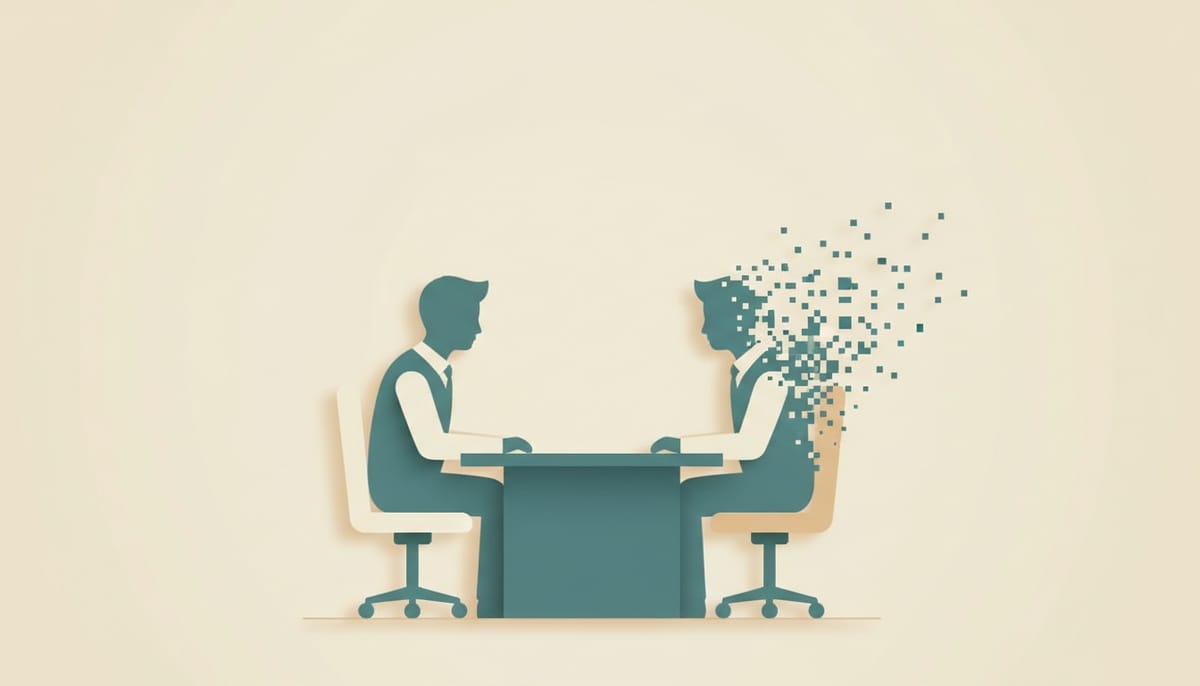
Before resigning from Baidu this spring, an algorithm engineer the press calls Wei Ying spent his final week on a new kind of handover. Instead of writing documentation and walking a successor through his projects, he built an AI version of himself. Coworkers fed his code, documents, research, and chat histories into an internal system trained to mimic how he solved problems and how he talked to colleagues. Within a week, by his own estimate, the bot could replace 90 percent of his work. After he left, his former teammates kept messaging "Wei" with technical questions, assigning it tasks, even sending it voice notes. It has its own avatar.
That story, reported by Sixth Tone this week, is not an isolated experiment. Chinese tech companies are increasingly asking departing employees to train digital replicas as part of the exit process, and MIT Technology Review has been tracking the same pattern since spring. It is worth taking seriously, because the problem these companies are trying to solve is completely real. Their solution is what deserves scrutiny.
The handover problem is genuinely brutal
Every operator knows the feeling. A senior person resigns, and the two-week notice period becomes a frantic exercise in archaeology. Where are the credentials? Why is the deploy script written that way? Which client hates morning calls? What did we promise that vendor in 2024?
The standard tools for this are bad. Handover documents capture maybe a tenth of what someone knows, because most working knowledge is not the kind of thing people think to write down. It lives in habits, judgment calls, and context accumulated across hundreds of small decisions. Exit interviews capture even less. The successor inherits a wiki page and a prayer.
So when an internal AI system offers to ingest years of someone's code, messages, and documents and answer questions the way that person would, you can see why managers reach for it. Institutional knowledge walking out the door is one of the oldest and most expensive problems in business. The companies running these replica programs are not being absurd. They are responding to real pain.
Cloning a person is the wrong abstraction
The trouble starts when you look at what is actually being built: a model of a specific human being, trained on their personal communication patterns, deployed under something close to their identity, without much clarity about consent, ownership, or liability.
The legal exposure alone should give any company pause. Chat messages, emails, and work habits are personal information under China's data protection laws, and most other jurisdictions treat them similarly. Nobody has settled who owns a model distilled from a person's professional behavior, what happens when that model makes a costly mistake under the departed employee's name, or whether the employee can demand its deletion two years later. These are not edge cases. They are the first questions any dispute will raise.
The human dynamics are worse. Sixth Tone reports that workers, suspecting they were training their own replacements, started withholding parts of their workflow and experimenting with "anti-distillation" tools designed to hide how they work from the company's AI systems. Think about that for a moment: the knowledge-preservation program is actively teaching employees to hoard knowledge. The incentive structure defeats the goal. The moment your people believe that sharing context feeds a replica that replaces them, your knowledge problem gets dramatically worse, not better.
And then there is the simple technical reality that a replica is a snapshot. "Wei" knows everything the real Wei knew in his final week, and nothing after. Systems change, clients churn, decisions get reversed. A frozen imitation of a former employee decays from the day it ships, while wearing the face of someone who is no longer there to correct it. A colleague who left the company still appears to vouch for answers he never gave.
Knowledge should belong to the role, not haunt it
Here is the reframe that makes the problem tractable: the company never needed a copy of Wei. It needed the knowledge that happened to live in Wei's head, captured continuously, owned clearly, and kept current.
That points to a different architecture. Instead of distilling a person on their way out, you give the team a durable institutional memory that accumulates while everyone is still there. In practice, that looks like an AI employee that works alongside the team from day one: it sits in the projects, reads the threads it is part of, executes real tasks, and remembers all of it. The memory belongs to the workspace, not to any individual's ghost. When a human teammate leaves, nothing dramatic needs to happen, because the context they shared in the course of normal work is already part of the team's operational memory, attached to the systems and decisions themselves rather than to a simulated personality.
The differences from the replica approach are not cosmetic. Consent is structural: an AI coworker accumulates what was shared with it openly, in its own identity, rather than being secretly assembled from someone's private message history. Accountability is clean: the AI acts under its own name, with its own audit trail, so nobody's reputation is borrowed posthumously. And the memory is alive: it keeps updating after any individual departs, instead of decaying from a snapshot.
There is also a quieter benefit. When the institutional memory is a teammate rather than a replica, sharing knowledge stops feeling like training your replacement and starts feeling like delegating to a colleague. The incentive arms race never starts. Nobody buys anti-distillation tools to hide from a coworker who handles the follow-ups they did not want anyway.
The replica trend will get bigger before it gets better
Expect more of these stories, not fewer. The handover problem is universal, the tooling to build replicas is getting cheaper, and the legal frameworks are years behind. Some companies will ship employee clones, take the liability, and quietly absorb the cultural damage when their best people start working with one hand behind their back.
The companies that get this right will be the ones that separated two ideas the replica programs blur together: preserving what someone knows is legitimate and urgent; impersonating who someone is solves nothing and poisons trust. Build the memory into the team while people are still in the room, give it a clear identity of its own, and the departure of any one person, human or otherwise, stops being an existential event.
Want to test the most advanced AI employees? Try it here: https://Geta.Team