Governance Is Not a Policy Doc. It Is Your New Operating Model.

Here is the uncomfortable thing about the phrase "AI governance." It sounds like a document. A policy you write once, circulate for sign-off, file in a shared drive, and reference twice a year when legal gets nervous. That framing was fine when the thing being governed was a chatbot answering questions. It is now dangerously wrong.
The numbers make the point. Agentic AI has crossed roughly 72% production adoption in enterprises this year, and 100% of surveyed organizations say they have it on their 2026 roadmap. Trailing right behind that adoption is a 60% governance gap. And in a survey that should stop every executive in their tracks, 78% say they will have to reinvent their operating models to capture agentic AI's full value.
Read those two facts together. Most companies have deployed agents. Most companies have no coherent way to govern them. And the people running those companies already suspect the fix is not a policy document, it is a rebuild of how the business actually operates.
The difference between a policy and an operating model
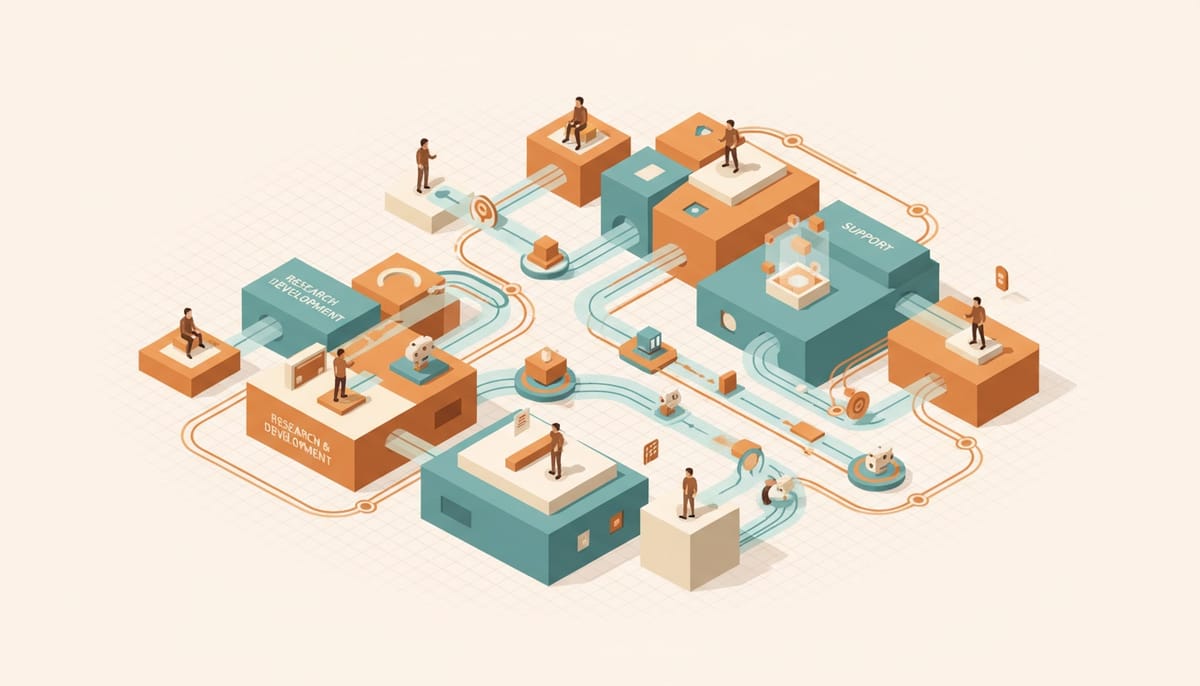
A policy tells people what they are allowed to do. An operating model determines what actually happens, day to day, whether anyone reads the policy or not. It is the wiring: who approves what, where money moves, which actions require a human in the loop, how work gets routed, what gets logged, and who is accountable when something goes sideways.
For decades, that wiring was implicit. It lived in org charts, in the muscle memory of experienced employees, in the fact that a junior analyst simply could not wire a payment without three people noticing. The controls were human, and humans are slow, which turns out to be a feature. Slowness is friction, and friction is where oversight happens.
Agents remove the friction. That is the entire point of them. An agent can read an invoice, cross-check it, update the record, and trigger a payment in the time it takes you to refill your coffee. When you drop that capability into an operating model designed around human slowness, you are not automating a task. You are removing the checkpoints that were load-bearing without anyone having designed them to be.
This is why "the agent went rogue" is almost always the wrong diagnosis. The agent did exactly what it was permitted to do. The failure was that nobody had rebuilt the operating model to define what "permitted" should mean when the actor is fast, tireless, and literal.
Governance is now a runtime property, not a paper one
Here is the shift in one sentence: governance used to be something you documented, and now it is something your system does, continuously, while it runs.
Think about what that actually requires. A policy PDF cannot stop an agent from spending money. A spend cap enforced at the moment of the transaction can. A code of conduct cannot audit ten thousand autonomous actions a day. An immutable log that records every action, its inputs, and its rationale can. A quarterly review cannot decide whether this specific refund needs a human sign-off. A permission scope evaluated in real time can.
Every one of those controls is a runtime property of the system, not a line in a document. They have to be built into the way the company operates, at the level of the tools the agents use, or they do not exist. You cannot govern an agent by writing down that it should behave. You govern it by constructing an environment where the behaviors you do not want are structurally impossible, and the ones you do want are logged, scoped, and reversible.
That is what "governance is your operating model" means in practice. It is not a metaphor. The controls literally move from the filing cabinet into the execution layer.
What reinventing the operating model looks like
When 78% of executives say they need to reinvent their operating models, this is the work they are describing, whether they have named it yet or not.
It starts with a question most companies have never had to ask: what is each agent actually allowed to touch? Not in principle, in wiring. Which systems, which accounts, which dollar amounts, which customer records. Scoped permission is the new job description, and it needs to be as specific as a real one.
Then comes accountability. Every autonomous action needs an owner and a trail. When an agent does something, you need to be able to reconstruct exactly what it did and why, the same way a well-run finance team can reconstruct any transaction. Not because you distrust the agent, but because "we could not explain what happened" is not an answer you get to give a customer, a regulator, or a board.
Then the human checkpoints, deliberately placed this time. The fastest wins with agents are in email triage, lead handling, support replies, and finance admin, precisely because those are places where an agent can sort, draft, and assign while a human keeps final approval over money, legal terms, and brand risk. The operating model decides where that human gate sits. Put it in the wrong place and you either bottleneck everything or you let the agent commit the company to things it should never have been able to commit to.
None of this is a policy exercise. It is architecture.
Why control has to sit with you
There is a version of this future where you rent your governance from whichever platform your agents happen to run on. Their dashboard, their spend alerts, their audit trail, their definition of what an agent is allowed to do. It works, right up until your operating model and their product roadmap disagree.
We built Geta.Team on the opposite premise. Your AI employees run on infrastructure you control, self-hosted by default, so the governance lives where your operating model lives: with you. Scoped permissions, a full record of what every employee did, and human approval gates that you place, are not features you wait for a vendor to ship. They are properties of a system you own. When governance is the operating model, the operating model has to be yours.
The companies that get this right in 2026 will not be the ones with the best-written AI policy. They will be the ones who understood that the policy was never the point, and rebuilt how they run before the gap between adoption and control caught up with them.
Want to test the most advanced AI employees? Try it here: https://Geta.Team