
OpenAI Shipped an AI Employee. It Costs $200 a Month and You Get Exactly One.


For $200 a month, ChatGPT Pro now comes with an always-on AI agent that carries on working after you close the tab. It has its own cloud computer, its own browser, and it learns how you like things done.
You get one.
That is the shape of Dots, which OpenAI launched at DevDay on Monday, and it is worth taking seriously, because most of it is right. The interesting part is what the shape costs you later.
What a seat gets you
A dot is an always-on personal agent running on GPT-6 Astra. You name it. It learns your preferences and habits over time and reaches more than four thousand apps through OpenAI's plugin ecosystem.
It costs $200 a month on ChatGPT Pro, or $100 per seat on Business Premium, with the first dot included. OpenAI has said more dots are coming. It has not said what they will cost.
Each dot runs on its own cloud computer, with its own browser, and you can open that computer at any moment and watch it work.
Three things here are genuinely good
Credit where it is due, because the criticism only counts if the praise is honest.
Its own computer, which you can open. This is the best answer anyone has given to the observability problem. Not a log you have to interpret, not a summary the agent wrote about itself, but the actual desktop it worked on. More vendors should copy this.
Custom Rules. You can tell a dot to allow something, to ask for approval, or to block it outright. That is the right shape for agent permissions, and plenty of products shipping today do not have it.
It learns your preferences over time. Correcting an agent once and having the correction stick is the difference between a colleague and a very fast intern on their first day, every day.
The debate about whether AI employees are a real category has quietly ended. OpenAI just shipped one.
We have spent a year arguing that the useful unit is not a chatbot you prompt but a persistent, named worker that holds context, acts on real systems and can be inspected. Plenty of people called that marketing language. It is now the roadmap of the largest AI company in the world.
Which leaves three open questions, and they are the ones worth your attention.
One: you get a dot, not a team
OpenAI is explicit that you begin with one primary dot, and says it envisions teams of dots eventually. Eventually is doing a lot of work in that sentence, and the honesty is welcome.
Here is why the shape matters. Work does not arrive in one form. The agent chasing your unpaid invoices should not be the agent drafting your marketing, and not because one agent lacks the raw capability. It is because a role is a set of boundaries, and boundaries are what make delegation safe.
An agent with one job has a defined scope, a defined set of systems it may touch, and a defined answer to what it should escalate. An agent with every job has none of those, and the moment you give a general-purpose agent access to everything, you have to supervise everything.
A role is a set of boundaries, and boundaries are what make delegation safe.
Memory is the other half. Context that compounds is the most valuable thing an agent accumulates, and it compounds per role. Your support agent should know your refund exceptions and your three difficult accounts. Your sales agent should know your pipeline and how much you will discount. Pour both into one place and you get an agent that knows a great deal and specialises in nothing.
One dot per seat is also a pricing model, not only a design. It scales by adding people, not by adding work.
Two: one model, chosen for you
A dot runs on GPT-6 Astra. That is an excellent model and it is the only one on offer.
This matters more than it sounds. Different work genuinely suits different models, and the cost gap between a frontier model and a fast mid-tier one is wide enough that pointing routine work at the expensive option is simply waste. Choosing per task, or per role, is worth real money at volume.
It matters strategically too. Any capability you build on one provider's model is a capability you rent, on terms that can change. We wrote about that when Amazon froze Bedrock Agents and everyone who had built on it inherited a migration nobody planned.
Three: where it runs, and who can have it
Be precise about this one, because the coverage has been sloppy.
Pro users in the European Economic Area, the United Kingdom and Switzerland cannot get Dots at launch. Business Premium users can, across supported regions. So a European company on the right plan is fine, and a European professional paying $200 for Pro is not.
That is a scheduling reality of shipping into regulated markets, and it will presumably resolve. But "presumably resolve" is not a plan if you are running a business in Paris or Manchester this quarter.
The question that outlives the rollout is where the work happens. A dot's cloud computer is hosted by OpenAI. Your agent's accumulated context, the asset that gets more valuable every month, lives on infrastructure somebody else owns and governs. For many businesses that is a perfectly reasonable trade. For anyone handling client confidential material, working in a regulated sector, or likely to meet an auditor asking what an automated system did with personal data, it is not a detail.
Side by side
Checked on 30 September 2026, from OpenAI's launch material and our own documentation. Dots launched the day before, so some details are not public yet.
| Dots | Geta.Team | |
|---|---|---|
| Agents | One primary dot | Unlimited, or 250 on BYOK |
| From | $200 a month | $149, or $49 with credits |
| Model | GPT-6 Astra | Your pick, per employee |
| Runs on | OpenAI cloud | Your server, EU, US or on-premise |
| Europe | Not Pro at launch | Germany, France, anywhere |
| Phone | Coming soon | Live, 21 languages |
| Own email | Not announced | Yes, a real mailbox |
| Approvals | Allow, ask, block | Guardrails, skills per employee |
| Inspect it | Activity View | Audit trail and live dashboard |
| Orchestration | Announced | Nova dispatches the team |
"Not announced" means we found no mention in OpenAI's launch material. We will revise as Dots evolves.
Where Dots is ahead
Two things, and they are not small.
Distribution. It lives inside ChatGPT, which your team may already have open all day. Nothing to adopt, nothing to explain, no new tab. That advantage is enormous and no competitor can buy it.
One vendor. The model and the agent come from the same company and are tuned together. When GPT-6 Astra changes, the agent around it changes with it. That coherence is real, and it is the flip side of the model-choice argument: you give up flexibility and you get tight integration.
If you want one personal assistant inside the app you already live in, and you are not a European Pro subscriber, Dots is a good product and you should try it.
What to actually do
If you have access, use it. Pick one recurring job with a clear finish line, hand it over completely, and watch what happens on that cloud computer. You will learn more in a week than from any amount of reading, including this.
Then ask the three questions the launch leaves open:
- What happens when the work needs a second agent with a different scope
- What happens when this job would be better and cheaper on a different model
- What happens when somebody asks you where the data went
Those are not objections to Dots. They are the questions that decide whether what you build on any agent platform survives contact with your actual business.
The category is settled. The design decisions are what is still up for grabs.
Our answer, for what it is worth
We build the other shape: a team rather than a seat, a model you pick per employee, and a server in Europe or the US that is only yours.
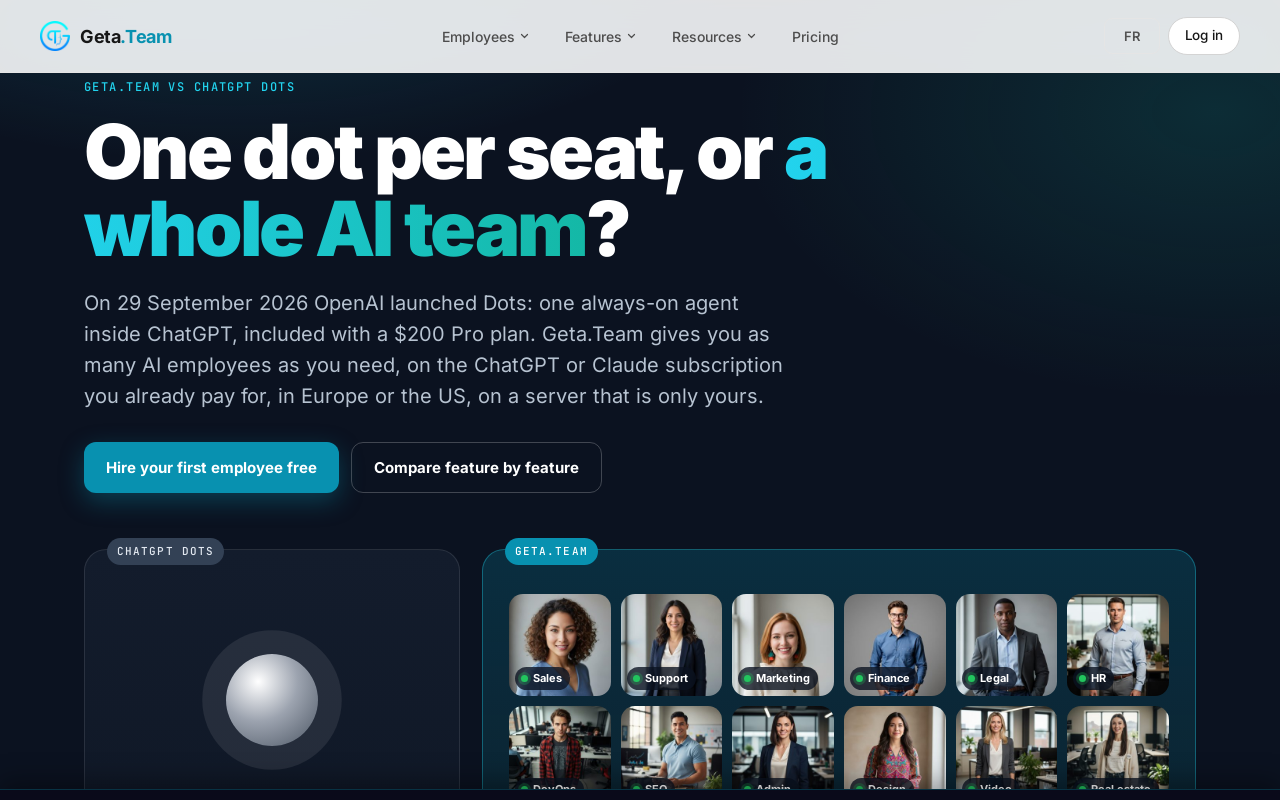
The full capability-by-capability comparison, including the parts where Dots wins, is on this page.
Want to test the most advanced AI employees, as a team rather than one at a time, on models you choose and infrastructure you control? Try it here: https://geta.team