The Multi-Agent Correction: One Good Agent Beats Five Mediocre Ones

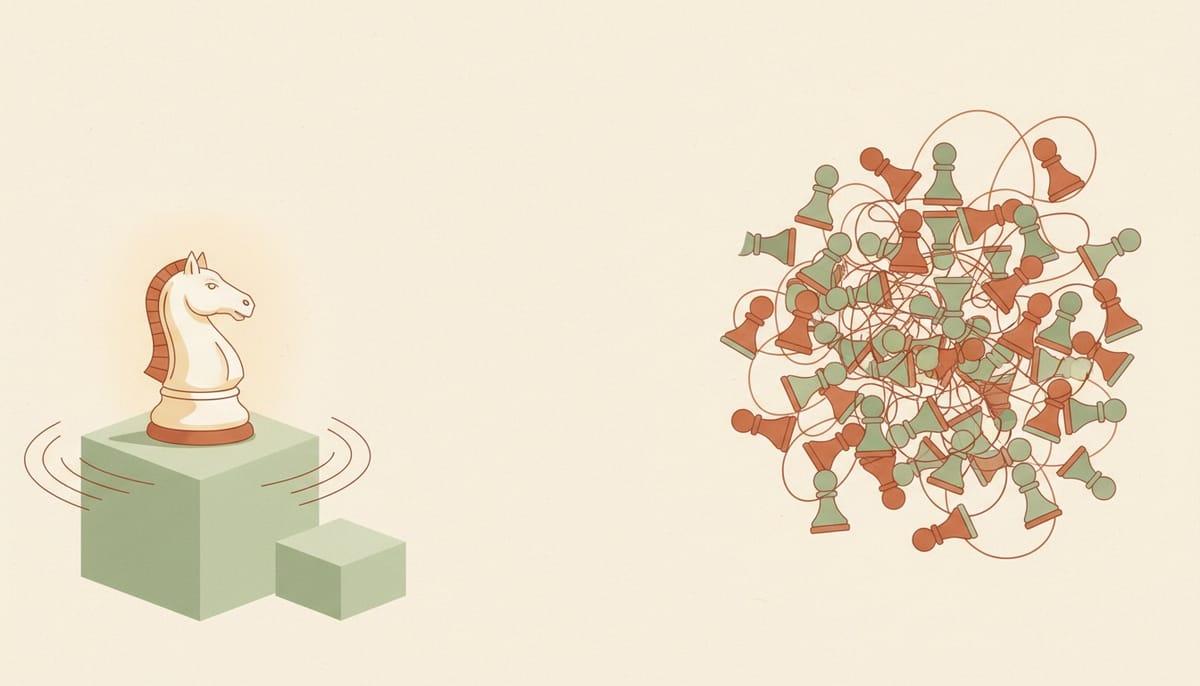
Sometime in 2025, "multi-agent" stopped being an architecture and became a personality trait. Every demo had a swarm. Every diagram had five boxes labeled Researcher, Planner, Critic, Executor, and Summarizer, connected by a tangle of arrows that looked less like a system and more like a subway map drawn during an earthquake. The pitch was always the same: one agent is a toy, but a team of specialized agents is a workforce.
A year later, the people actually running these things in production have quietly landed on a different conclusion. Most of those swarms were coordination overhead wearing a costume. The 2026 lesson, now being said out loud by the same folks who were building the swarms, is blunt: multi-agent makes sense only when one agent genuinely isn't enough. And that threshold is a lot higher than anyone wanted to admit.
Why five agents felt smarter than one
The appeal was real, and it wasn't stupid. Splitting a job across specialists maps neatly onto how human teams work. You wouldn't ask one person to research, write, fact-check, and design a report, so why ask one agent? Break it into roles, give each a narrow prompt, and let them hand off. Cleaner. More modular. Easier to reason about on a whiteboard.
The problem is that agents don't fail like an org chart. They fail like a game of telephone.
Every handoff between agents is a lossy compression step. The researcher finds twelve relevant facts, writes a summary that keeps eight, and passes it to the planner, who reads six of them correctly and builds a plan around four. By the time the executor acts, it's working from a blurry photocopy of the original intent. Nobody made a mistake, exactly. The context just evaporated one handoff at a time.
And because each agent only sees its slice, none of them can catch the drift. The researcher doesn't know how its summary will be used. The executor doesn't know what got dropped upstream. You've built a system where the failure is invisible to every individual component, which is the worst kind of failure to debug.
The context tax nobody priced in
Here is the part that shows up on the bill. Multi-agent systems don't just risk quality, they cost more, and often a lot more.
Every agent in the chain needs context to do its job. That means the same background, instructions, and prior state get re-serialized and re-sent at every hop. A single capable agent reads the situation once and keeps it in working memory. A five-agent pipeline pays for that context five times over, plus the tokens spent summarizing between stages, plus the retries when a handoff garbles something and a downstream agent produces nonsense that has to be caught and redone.
Teams optimizing token spend this year are reporting that a meaningful chunk of the waste comes from exactly this: coordination chatter, redundant context, and tool-call overhead that exists only because the work was split up in the first place. You can spend real engineering effort minifying tool calls and compressing prompts, or you can not fan the work out to five agents that didn't need to be five agents.
What one good agent actually looks like
The alternative isn't a dumber system. It's a more capable single agent, and the difference comes down to three things.
The first is deep context. One agent that holds the full picture of a task, from the original goal to the current state, doesn't lose fidelity across handoffs because there are no handoffs. It reasons over the whole problem at once. When it needs to reconsider an earlier step, the earlier step is right there, not locked inside another agent's memory.
The second is real skills, not personas. A lot of "specialist agents" were just the same model with a different system prompt telling it to act like a researcher. That's not specialization, that's roleplay. Genuine capability comes from giving one agent actual tools: the ability to search, to run code, to call an API, to read and write files, to remember what happened last week. A single agent with a real toolbox beats five agents cosplaying as departments.
The third is persistent memory. The reason human specialists work is that each one carries months of accumulated context about your business. Most multi-agent systems throw that away between runs, so every session starts from zero. An agent that actually remembers your preferences, your past decisions, and the outcome of the last ten tasks is worth more than any fresh-off-the-line committee, because it's building on something.
So when do you actually want a second agent?
Not never. The honest test is genuine parallelism or genuine isolation, not conceptual tidiness.
Reach for a second agent when the work is truly independent and can run at the same time: scanning two hundred documents where each is its own island, or hitting a dozen data sources concurrently because waiting for them in sequence would take all day. That's parallelism paying for its own overhead.
Reach for isolation when you need a hard boundary, like a separate agent with tightly scoped permissions handling anything that touches money or production systems, so a mistake in one lane can't spill into another. That's a security decision, not an architecture flex.
Everything else, the plan-then-critique-then-execute pipelines, the researcher-writer-editor relay races, is usually one capable agent that got chopped into pieces for the sake of a cleaner diagram. If your second agent's whole job is to read the first agent's output and pass it along, you didn't build a team. You built a bureaucracy.
The takeaway
The swarm was a phase. It was a reasonable thing to try, and the industry learned what it needed to learn: that coordination is not free, that context is the scarce resource, and that adding agents adds failure modes faster than it adds capability. The teams shipping reliable agentic systems in 2026 mostly aren't running elaborate multi-agent orchestras. They're running one strong agent with deep context, a real set of skills, and a memory that persists, and they add a second agent only when the work genuinely demands it.
This is the whole idea behind how we build at Geta.Team. An AI employee isn't a swarm you have to orchestrate. It's one capable coworker with persistent memory, real skills it can extend on demand, and enough context to actually own a task from start to finish. When you do need a second one, they collaborate like colleagues, not like a game of telephone.
Want to test the most advanced AI employees? Try it here: https://Geta.Team