Anthropic's Claude for Small Business Just Shipped. Here's How It Compares to Hiring an AI Employee Instead.

Anthropic shipped Claude for Small Business this past week, and the reception has been broadly positive: native integrations with QuickBooks, PayPal, HubSpot, Canva, and Docusign, fifteen prebuilt workflows out of the box, pitched explicitly at the SMB segment that never had budget for a real automation team. Good product, real shipping. But the more interesting question — the one nobody seems to be asking out loud — is whether "Claude for Small Business" is the right shape of product for the problem SMBs actually have.
I'd argue it isn't. And the difference matters more than the feature list.
What Claude for Small Business actually is
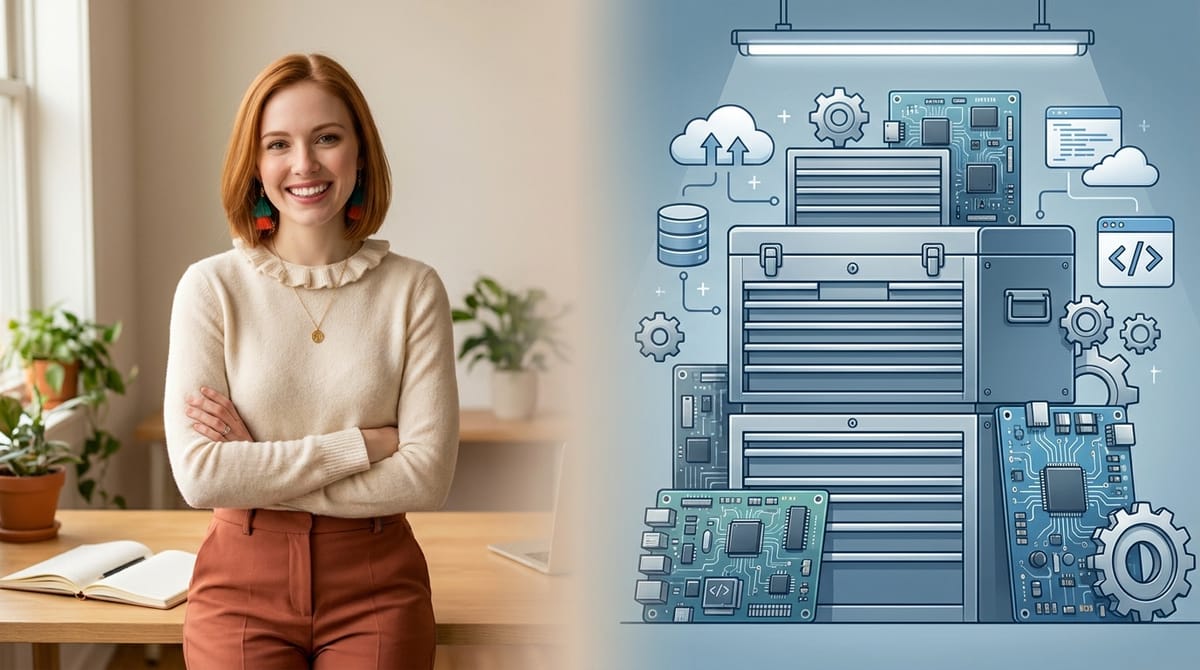
Strip the marketing language away and Claude for Small Business is a smart toolkit. It's Claude (the model) plus a curated set of integrations (the connectors) plus fifteen recipes (the workflows). The model is excellent. The integrations are real. The recipes are useful. Put together, it's a meaningfully better starting line than a blank ChatGPT tab.
But the unit of consumption is still: you, the SMB owner, sitting down to configure a workflow. Maybe you don't write the workflow yourself — you pick one of the fifteen prebuilt ones. But you're still the architect. You're still deciding which recipe runs on which trigger, which fields map where, which exceptions need human review. The agent is a tool you wield.
That works for some businesses. Specifically: businesses with a clear, documented process and someone who has time to think about workflow design. Which is a smaller subset of SMBs than the marketing suggests.
What most SMBs actually want
The SMB owners I talk to don't want fifteen workflows. They want one teammate.
When I sit down with a solo founder or a 12-person agency owner, the conversation doesn't sound like "which workflow should we automate first." It sounds like "I'm drowning in inbox triage and follow-ups and content production and client check-ins and I need help." The pain isn't workflow-shaped. The pain is teammate-shaped.
The mental model they're operating from is: "I need to hire someone, but I can't afford to." Not: "I need to design a workflow, but I don't have time to."
This is a small framing difference that becomes a huge product difference. A toolkit answers the workflow question. An AI employee answers the hire question. And the gap between those two answers is roughly the gap between "I downloaded another SaaS subscription" and "I have a teammate I can ask for help."
Where the toolkit model breaks
The fifteen prebuilt workflows in Claude for Small Business are good. They are also, by definition, a finite set. The moment your business has a sixteenth need — and it will, fast — you're either back to building your own workflow (the thing you were trying to avoid) or waiting for Anthropic to ship a recipe that fits.
This is the structural problem with the recipe-collection approach. The number of distinct workflows in real SMB operations isn't fifteen. It's not fifty. It's effectively unbounded, because every small business does some things idiosyncratically. The accounting workflow at a marketing agency is not the accounting workflow at a dental clinic. The client onboarding at a consulting firm is not the client onboarding at a yoga studio.
A toolkit with fifteen recipes solves the 80% case — the workflows that are common across SMBs. It can't solve the 20% that are specific to your business. And the 20% is usually where the real time gets sunk.
The AI employee model handles this differently. You don't pick from a menu of prebuilt workflows. You describe what you need in plain language, the same way you would brief a new hire, and the employee figures out the workflow. New requirement next week? Brief them on the change. They learn. They keep going.
The persistent-memory gap
The second thing the toolkit model misses is identity over time.
A workflow runs, completes, and forgets. It doesn't remember that Acme Corp called twice last week, that Jane prefers email over Slack, that you usually escalate procurement decisions after 24 hours rather than 48. Every workflow run starts from zero context, gets configured with whatever fields you pass it, executes, and exits.
A teammate accumulates context. A real EA learns over the first three months who your important clients are, which Slack channels to mute, which meetings you actually need to be in. By month six, they're proactively flagging things you didn't notice. By month twelve, they're irreplaceable not because of any specific skill but because of everything they remember.
AI employees with persistent memory are reaching for this. The fifteen-workflow toolkit isn't — not because Anthropic couldn't add memory, but because the unit of consumption is the workflow run, not the relationship.
When the toolkit is actually the right answer
To be fair: there are SMBs for whom Claude for Small Business is the right product. The shape that fits well:
- You have one or two well-defined, repetitive processes you want to take off your plate (invoice processing, signature collection, lead enrichment)
- You're comfortable thinking about your work as workflows
- You don't need cross-process intelligence — you just need each workflow to run
That's a real segment. It's also a smaller segment than "all SMBs." And the broader you go — the more eclectic and judgment-driven the work, the more it spans accounting and sales and customer comms and content production — the worse the toolkit model fits.
What this means for SMB AI adoption
I think the next 18 months will sort SMBs into two camps. One camp will keep buying toolkits — Claude for Small Business, the workflow-builder platforms, the recipe collections. They'll get utility from them, especially for the well-defined processes. The other camp will skip the toolkit layer entirely and hire an AI employee directly: a teammate with a name, a memory, an inbox, and the ability to learn whatever skill the business needs next.
The first camp will tell themselves they're being practical. The second camp will quietly outproduce them by Q4.
The Claude for Small Business launch is a good moment to ask which camp you want to be in. Toolkits scale to a ceiling. Teammates compound.
Want to test the most advanced AI employees? Try it here: https://Geta.Team